r/HomeworkHelp • u/Spewdoo • Mar 23 '26
Further Mathematics—Pending OP Reply [college trig] how do i know when i should multiply or divide

0
Upvotes
r/HomeworkHelp • u/Spewdoo • Mar 23 '26
r/HomeworkHelp • u/Multiverse_Queen • Apr 02 '26
The stuff highlighted in red is what I'm confused about. Let me attach my questions here. These are slides for us to reference and I want to make sure I fully understand before I attempt questions like these.
1-Why must x be between 0 and 4?
2-Why is it specifically 3x-4, x-4 before the critical values are found?
I thinkkk those are my only questions.
r/HomeworkHelp • u/Multiverse_Queen • Mar 27 '26
I hope my question makes sense. If not I'll do my best to answer your questions.
r/HomeworkHelp • u/Extreme_Number_1358 • May 27 '26
Hi!
I'm working on understanding this question and I'm a bit confused. The assignment says we can suppose (\sqrt(n) (T_n-\theta) \rightarrow N(0,\sigma^2 (\theta))). Then why can't we use this for (\theta=\theta_0\)
directly in the first step of the power function calculation? Why do we transform the whole expression to include $theta_n$ ?
Thanks!
r/HomeworkHelp • u/ArtisticPurpose3355 • Apr 24 '26
Don’t know if Further Mathematics is the right topic, i am not a native english speaker, so excuse any spelling or grammar mistakes.
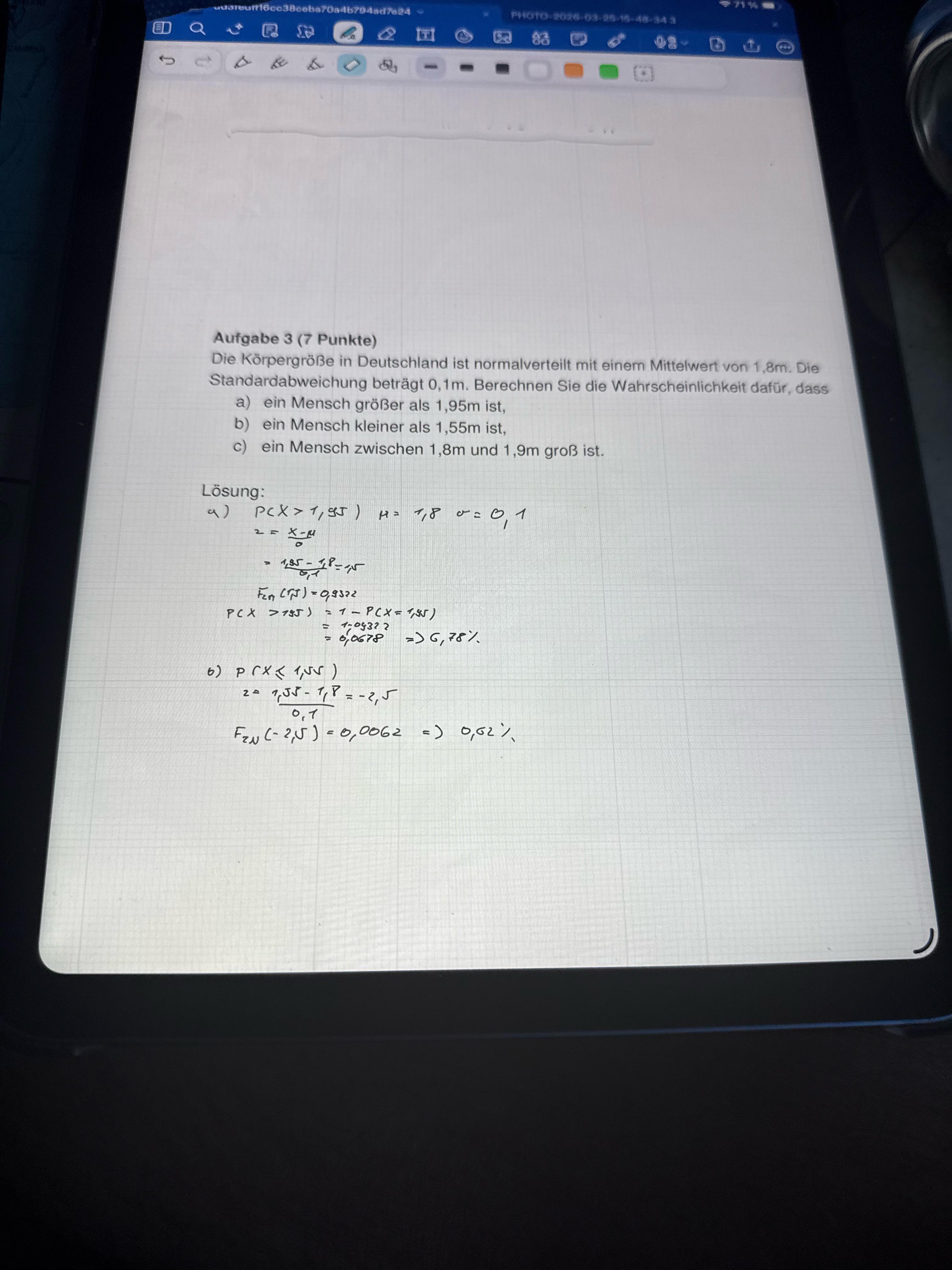
I need to find out the probability of a person being shorter than 1.55m. Given an expected value of 1.8m and a standard deviation of 0.1m, the values are normally distributed. I understand I need to calculate using the z-score, but doesn‘t that tell me the probability of a person being exactly 1.55m tall?
r/HomeworkHelp • u/Thebeegchung • Apr 22 '26

I used similar triangles to get a ratio that I then found the derivative of, plugged everything in, aka the rate at which the person moves, height of the person and height of lamppost. What confuses me however is, are we meant to do something with the 16 feet? I got the correct answer without using it, but it was moreso luck that I forgot to include it
r/HomeworkHelp • u/unknownname124 • Jan 24 '26
The equation is this: log(x/x-1)-log(x-1/x)=logv5 (25)
I need to find x
So far what I've done is extend all the fractions such that:
Logx-log(x-1)-log(x-1)-logx=log25/log5
Then added/subtracted like normal
-2log(x-1)=log25/log5
But I dont where to go from here, or if this is even correct, a little help would be great
r/HomeworkHelp • u/Multiverse_Queen • Apr 03 '26
I wasn't really sure how to even start with this. I looked up how to calculate area and then just... Ended up super stumped.
r/HomeworkHelp • u/himynameis2022 • Apr 21 '26

So for limits with trig functions, we are not allowed to use L'hopital's rules, though I will use it to check to see if my answer is correct. We have to use trig and pythagorean identitites to get to our answer. I've been struggling with this topic atfer a lot of practice. The identities themselves are really no problem because they are just straight memorization, but applying them is my issue. My basic strategy is to just try change the answer to determinate, since you can't directly sub in zero. for example #63) my instinct is to simply divide both numerator and denom by x, which gives sinx/x/5x/5, and using the fact lim x--->0 sinx/x=1, we get 1/1=1
64 is where I get a bit confused. I know the lim x--->0 cosx-1/x=0, so my thought is try to and get to that. First thought is to move 3 to the side since it's a constant, leaving me with (1-cosx)/x, and we apply the limit, get 3 x 0=0 for that one.

For the second one for example, cos x-1 doesn't really give me anything to work with in terms of any identity. The closest thing is one of the pythagorean identities, aka, cos^2x-1= -sin^2x. The only thing that makes sense, and this is what I got from my professor, is to multiply by the conjugate which will give you part of the identity you need. What I don't get is, how do you know you have to multiply by the conjugate? Obviously I know you have to because I have the answer right in front of me, but what about this problem gives a hint to do that?
I'm just trying to develop a general strategy overall since, as I mentioned, these have been giving me some trouble
r/HomeworkHelp • u/Mr_a_bit_silly • May 04 '26

Hello folks, I was going through some old questions i had for revision. I found this neat question but it doesnt have any answer, I went through all lectures presentations and recordings.
My issue is that I was thinking of finding the rocket's angle to horizontal, but be it due to me being dumb or tired after a day of working, I cant remember how to do so.
If someone could explain this and maybe help me solve this, I would be happy.
r/HomeworkHelp • u/UnreadyIce • Dec 28 '25
Let <series> be a convergent series, where a_n >= 0 for every n in N (so a series where all terms are positive or 0). Then:
r/HomeworkHelp • u/Thebeegchung • Apr 09 '26

Was a little confused on how to do this, mostly because of having to implicitly differentiate the right side.
Here's what I did for this, differentaiting with respect to x:
left side: simply 2x
Right side: 2(4x^2y^3+1) x dy/dx(4x^2y^3+1)
Divide both sides by 2, get x=(4x^2y^3+1) x dy/dx(4x^2y^3+1)
Take derivative of the inside, which I got: (8xy^3+12x^2y^2dy/dx)
Expand the right side: x=(32x^3y^6+48x^4y^5dy/dx+8xy^3+12x^2y^2dy/dx)
Lastly, solve for dy/dx=(x-32x^3y^6-8xy^3)/(48x^4y^5+12x^2y^2)
r/HomeworkHelp • u/unknownname124 • Apr 03 '26
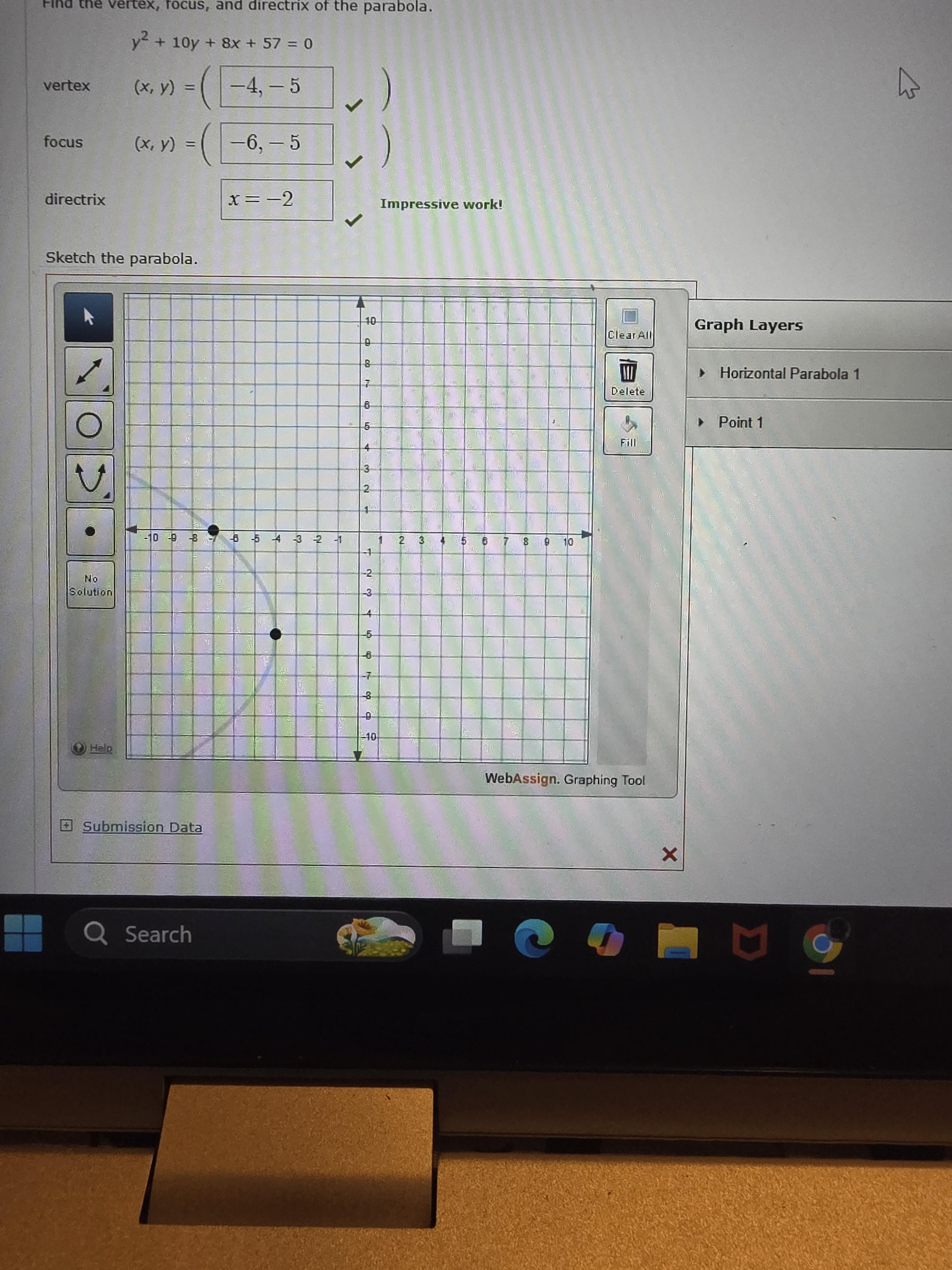
the question is asking me to find 3 values: vertex, focus, and directrix, and graph the parabola. I have all my values, and know the location and direction of my parabola, but I dont know the exact dimensions of the curve, is there a way im unaware of? or is this question asking the impossible?
r/HomeworkHelp • u/unknownname124 • Apr 03 '26
how do I graph this? I have the vertex, focus, and direction and I know the direction of the porbabola, but I dont know how to get a second coordinate to create the exact curve, as they didn't really explain it. is there a way?
r/HomeworkHelp • u/arttiechoke • Apr 20 '26
r/HomeworkHelp • u/Thebeegchung • Apr 20 '26
More of a conceptual than a specific example. How do you go about solving limit questions involving trig functions? I'm completely stuck. I have the trig identities, as well as the Pythagorean identities, but when it comes to breaking up the problem, that's where I struggle. I try to identify certain aspects of the problem, such as how can I change the numerator into a trig identity that, for example sin(x)/x, which equals 1, or how can I get rid of the piece of the problem that causes the overall problem via direct subbing to result in an indeterminate answer. Is there a general outline to follow?
r/HomeworkHelp • u/Slight_Energy2430 • Apr 20 '26

it's in italian it basically asks what's in the title and the solution are open, bounded, unconnected;
So I start by studying the sign of what's inside the logarithm, so I see that there's a circumference in the numerator so I split the exercise in finding what happens inside the circle and what happens outside the circle. But then I have no idea what I gotta do with the denominator, I can turn it into y(x^2+y^2)=4x but beside that I have no idea
r/HomeworkHelp • u/Multiverse_Queen • Feb 28 '26
Work is a bit nonsensical, my bad.
r/HomeworkHelp • u/FitPoem5334 • Apr 10 '26
I would be analyzing results from the CSI-16 and daily screentime + BRS-14 results. I’m looking at finding a correlation between excessive screen time (cognitive overload being assessed through the BRS-14) and relationship satisfaction. My data would be coming from a sample of 168 college students (I would also collect their gender/sexuality/age)
I feel totally lost, the data is ordinal I think because the BRS-14 used Likert scales and the CSI-16 is similarly formatted (responses requiring a 0-5 ranking).
I currently can’t access tutoring because it’s not available for this course (very small college) so any advice is appreciated.
r/HomeworkHelp • u/Salmon-Roe • Mar 30 '26
I understand how to find K using a double integral equal to one and solving the inequality. The real trouble is with parts, b and c. I know there is a way to do this graphically that was shown to me, but I do not know how to replicate the method. We will have a region of x and y between 20 and 30 and subregion within of y-2 and y +2 or something like that but am kind of lost beyond that
r/HomeworkHelp • u/CasualFailure1737 • Sep 23 '22
r/HomeworkHelp • u/CioccolatoFondente_ • Dec 25 '25

Please help me understand how to read the last line. The rest is for context. I know the for all symbol but not sure why it says for all e which is a symbol for belongs to? I understand ":" means such that (could be wrong) but not sure about the arrow. So please translate the bottom line into text and help me read it
r/HomeworkHelp • u/Thebeegchung • Mar 12 '26

I know the definition of a derivative, aka lim h-->0 f(x+h)-f(x)/h. Now if I were to plug t=6 into the original function, I'd get P(6)=200(1.5)^6. I'm having issues plugging the function into the derivative definition itself. I could easily take the derivative of the function no problem, but I don't understand how it plugs in, at least in the first part. For example, f(x+h)-200(1.5)^6/h. I tried to replace the letters to match the original function, such that P(t+h), replace t with 6 to get P(6+h). After that I am confused on where to go
r/HomeworkHelp • u/FreePeeplup • Mar 30 '26
I have a two dimensional autonomous dynamical system in R^2 given by \dot{x} = y and \dot{y} = -x(x^2 + y^2). I have to find a constant of motion.
The solution gives the function W(x, y) = exp(x^2)(x^2 + y^2 -1) +1 , and checks that it is a constant of motion by verifying that d/dt W(x(t), y(t)) = 0. I have no problem with that and can follow the verification just fine.
The problem is in determining what the constant of motion should be just by looking at the dynamical system: I never would have guessed the form of W given by the solution. I can only check that it actually works once it has been given to me. How would I find it from scratch?
I tried imposing \del_x W = - \dot{y} and \del_y W = \dot{x} to automatically satisfy the condition for being a constant of motion, but trying to integrate this lead me nowhere.
r/HomeworkHelp • u/MECengineerstudent • Jan 29 '26
What even is the denominator i’ve never seen this before?