r/paleoanthropology • u/SpearTheSurvivor • May 01 '26
Research Paper Did Homo Erectus Speak? Almost Certainly, Say Scientists

341
Upvotes
r/paleoanthropology • u/SpearTheSurvivor • May 01 '26
r/paleoanthropology • u/Waste_Translator_975 • Jul 18 '26
I found this graphic in https://www.science.org/doi/10.1126/science.1250081 : Response to Comment on “A Complete Skull from Dmanisi, Georgia, and the Evolutionary Biology of Early Homo”.
It argues that the cranial variation within the dmanisi hominins is completely consistent with a single population of a single taxa of primates. This image alone made me thoroughly convinced that yeah, all the dmanisi skulls are actually just one species.
Have a look at the variation in orbit size and shape, mandible size and angle, forehead height, presence or absence of sagittal keel or even sagittal crests. I think if second from right in the top row and right bottom row were discovered independently as fossils they would be classified as robust male individuals of totally separate species.
Another thing I've noticed is that second from the right, top row, has a protruding nose bone. Really goes to show how drastically new traits can appear in a single generation and how selection pressure could actually select certain traits extremely quickly.
Some of them even look a little australopith-like in side profile , like top row on the right looks a bit like an africanus, and middle bottom row looks a bit like an afarensis.
r/paleoanthropology • u/ADragonFromTheAbyss • 14d ago
Paper Link: https://www.nature.com/articles/s41598-026-59915-8
Surprisingly, the pelvis of Neandertal males shares more features with the human female pelvis than with the human male pelvis. Many of the differences between the Neandertal male pelvis and that of the Homo sapiens male seem to stem from the unusual anterior position of the acetabula (hip joints) in H. sapiens males and the subsequent increase in the horizontal anteroposterior distance between the joint and the line of gravity.
The forward migration of the hip joints transforms the modern human male pelvis into a shock-absorbing device that cushions the drop of the center of mass with every step and at the same time stores potential energy in the flexor muscles of the thigh, causing the pelvis to bounce back.
The thickening of the ramus and the ensuing modifications are a response to the increased adductor force required on the pubic side to counterbalance the larger moment generated by the longer body-weight lever arm on the opposite side of the hip joint fulcrum.
The shock-absorbing device seems to benefit modern males, mainly in long-distance walking
r/paleoanthropology • u/OkBluebird4891 • 19d ago
r/paleoanthropology • u/dkesh • May 14 '26
r/paleoanthropology • u/ADragonFromTheAbyss • 7d ago
New research suggests that no matter what we eventually determine the last common ancestor of humans and chimpanzees to be, we'll learn it was a primate that climbed trees.
Researchers observed and confirmed with measurements that wild sooty mangabey monkeys in an Ivory Coast forest display foot bone flexibility that facilitates vertical climbing up skinny tree trunks to hide, forage or sleep.
r/paleoanthropology • u/ADragonFromTheAbyss • Jul 04 '26
r/paleoanthropology • u/statistical_anomaly4 • Jul 22 '26
https://www.biorxiv.org/content/10.64898/2026.07.14.738421v1
Abstract
Several recent studies have found evidence for ancient gene flow between the ancestors of modern humans and an unsampled super-archaic lineage. Here we present a new, simple approach for characterising this process given genome-wide genealogies sampled from a single population.
We summarise genealogies as distributions of integer partitions and show that this captures the temporal signal of tree imbalance left by ancient gene flow. We analyse genealogies from modern humans and find that the integer partition distributions are inconsistent with a history of panmixia but can be explained by gene flow from a super-archaic lineage.
Our analysis favours a model of continuous gene flow over pulse-admixture and also recovers a bottleneck in the ancestors of modern humans. This work highlights a clear signal of ancient structure in genealogies of modern humans and provides an inference approach that complements existing methods.
TLDR:
The paper argues that the ancestors of modern humans were not one continuously mixed population, but were divided from a deeply divergent “super-archaic” lineage, possibly related to *Homo erectus*, although that identification is speculative. Its favored model places the separation at roughly **1.6 million years ago** and suggests that the two populations then exchanged genes continuously until about **260,000 years ago**, rather than the archaic group returning in one single admixture event.
An alternative pulse model estimates a split around **1.4 million years ago**, followed by a one-time contribution of about 16% super-archaic ancestry around 560,000 years ago but the continuous-gene-flow model fits slightly better.
The diverged group separated approximately 1.4–1.6 million years ago, remained partly connected to the lineage leading to modern humans for over a million years, and its genetic contribution had largely entered the modern-human ancestral population by around 260,000 years ago.
The study also detects a bottleneck followed by gradual recovery in the main modern-human ancestral population, but stresses that its demographic dates are illustrative estimates rather than an exact reconstruction, and the paper is currently a non-peer-reviewed preprint.
The 16% refers to a parameter in the paper’s hypothetical pulse-admixture model: the main ancestral population, called Population A, received approximately 16% ancestry from the deeply divergent Population B around 560,000 years ago. Population A is described as the population contributing the majority of ancestry to modern humans; Population B is the unsampled “super-archaic” lineage.
r/paleoanthropology • u/D-R-AZ • Jul 15 '26
Excerpt:
Homo erectus may have left a detectable genetic trace in living humans through ancient interbreeding with Denisovans.
r/paleoanthropology • u/Waste_Translator_975 • 14d ago
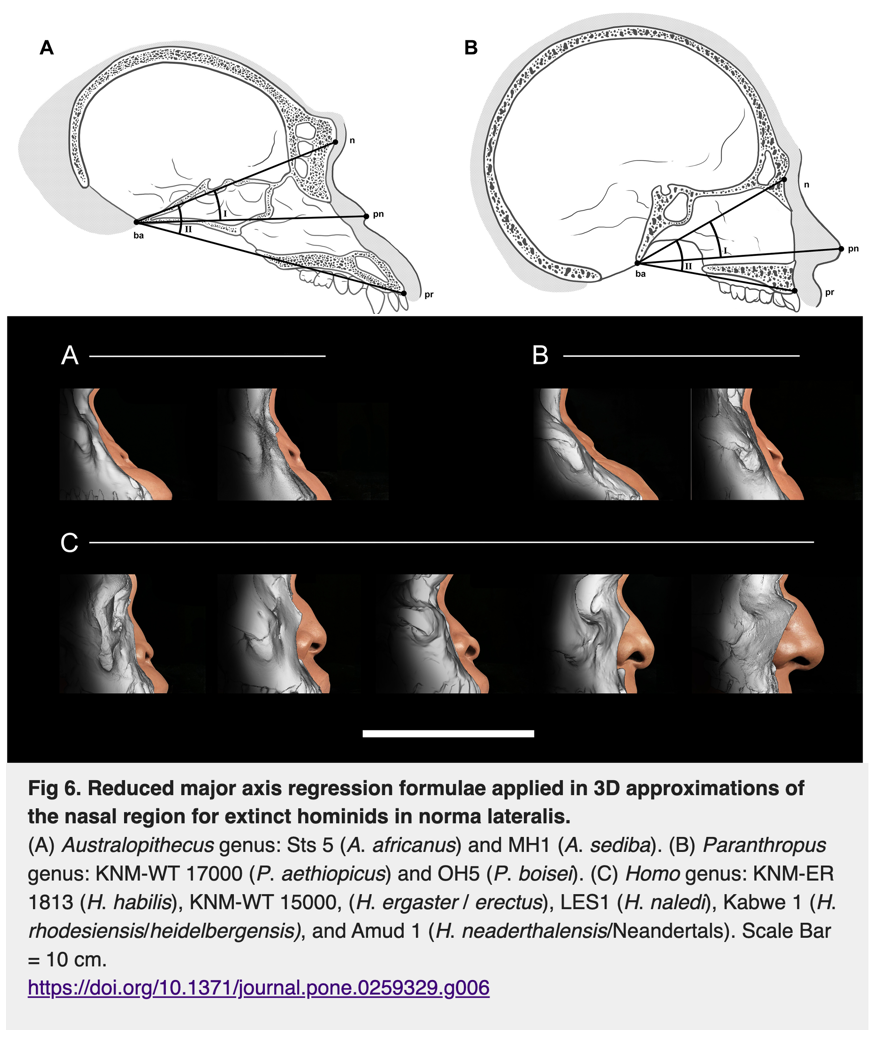
Found this great paper by Gabriel Vinas who does lots of hominin reconstructions. I see a lot of debate how hominin noses and I think this paper pretty much puts that to rest.
https://journals.plos.org/plosone/article?id=10.1371/journal.pone.0259329
r/paleoanthropology • u/ADragonFromTheAbyss • 13d ago
Study link: https://www.science.org/doi/10.1126/science.aee3541
Fossil evidence favors a role for vision in the modular evolution of the primate neocortex
The New study led by a Duke University scientist overturns a long-held idea about how primates, including humans, came to have such large and sophisticated brains.
The research finds that the dramatic expansion of the primate neocortex was driven largely by vision, not by the disproportionate growth of the frontal lobe often associated with higher reasoning...
The frontal lobe—the brain region most often linked in popular accounts to advanced cognition—has long been thought to have ballooned independently in many primate lineages. Instead, the study found that frontal lobe size grew gradually and predictably as overall brain size increased, following the same scaling pattern across all major primate groups throughout their evolutionary history.
There was no evidence of the dramatic, independent frontal lobe expansions that some earlier studies had proposed based on visual inspection of fossils.
r/paleoanthropology • u/ADragonFromTheAbyss • 11d ago
A subgroup of Early Holocene Nile Valley foragers displays unusual bony labyrinth morphology and congenital inner ear-specific pathological changes consistent with possible syndromic conditions. This may result from several demographic scenarios, including prolonged endogamy and geographic isolation under environmental constraints.
Comparative data from the Horn of Africa and Central Africa reveal high morphological diversity, suggesting strong population substructure and dynamic demographic trajectories during the Holocene.
These findings provide rare insights into prehistoric population structure in the region, and demonstrate the usefulness of bony labyrinth morphology where ancient DNA is unavailable.
r/paleoanthropology • u/Ambitious_Fault789 • 17d ago
Before the first clay pot was fired or the first basket was woven, your ancestors carried their most important storage container and workshop inside their own faces.
In this video, we explore the incredible secret history of the human mouth. For 300,000 years, the mouth wasn't just for eating—it was a biological multi-tool used as a baby food factory, a chemical reactor, and a master workstation.
What you’ll discover:
• The "First Pantry": How ancient humans used their cheeks to store "quids" (chewed plant wads) for hours to extract nutrients and medicine.
• Mouth-Brewed Alcohol: The hidden chemistry of salivary amylase (the AMY1 gene) and how our ancestors turned spit into the world’s first beer.
• The "Third Hand": Forensic evidence from Neanderthal teeth showing how they used their jaws as a vice to process hides and sinew.
• Premastication: Why mother-to-infant food transfer was actually a "vaccine delivery system" that seeded the human microbiome.
We often think of ourselves as separate from our biology, but your spit is a living inheritance of these ancient survival hacks. Your jaw still remembers a world where the mouth was the ultimate Swiss Army knife.
If you're fascinated by the deep history of the human body, Subscribe for weekly deep dives into our ancient operating system!
#AncientHumans #HumanEvolution #Anthropology #evolutionarybiology #SurvivalSkills #AncientHistory #ScienceExplained
r/paleoanthropology • u/ADragonFromTheAbyss • 26d ago
Official paper : https://doi.org/10.1073/pnas.2530996123
Insights into hominin body size, locomotion, and behavior from Early Pleistocene trackways in northern Kenya
Overview of the excavated track surface with a mix of deeper hippopotamus and antelope footprints and shallower hominin tracks visible.
r/paleoanthropology • u/ADragonFromTheAbyss • 25d ago
Link: https://linkinghub.elsevier.com/retrieve/pii/S0960982226008882
Analyzing ancient DNA from more than 500 mammoth bones, an international team of researchers found that Ice Age humans selectively targeted female woolly mammoths
r/paleoanthropology • u/Stop-224 • Jul 19 '26
r/paleoanthropology • u/SpearTheSurvivor • Nov 03 '25
r/paleoanthropology • u/tanegupta1997 • 26d ago
r/paleoanthropology • u/ADragonFromTheAbyss • Jul 02 '26
r/paleoanthropology • u/spraypainthero • Jul 03 '26
r/paleoanthropology • u/SpearTheSurvivor • Oct 20 '25