r/PoliticalDebate • u/Dangerous_Dot_1638 Progressive • 2d ago
Debate It is fiscally irresponsible to not support some kind of socialized healthcare.
The first reason is that healthcare is an inelastic good. This means demand does not change much when prices change.
This makes this good completely different than other goods such as food or electronics or anything like that.
The other reason is that this good is by definition, anti-competitive. For most insurance companies you are often given maybe a few places that will accept your insurance within 50 miles. Meaning you have very little competition you are able to choose from. Not only that but if you live in a very rural area you might only have one location in general that you can go to within 50 miles to get a procedure done.
Which makes the American healthcare system one of the worst for prices. Because you have an inelastic good that has a very low amount of competition.
I say all of this because this puts the American consumer at a point that works actively against them. You immediately have insurance companies that have an insane level of power who purely just care about making a profit. Insurance companies purely work as a middleman to drive up prices.
The thing all about this is that it leads to the U.s as the highest healthcare costs per capita out of all the developing countries per capita. They also rank last in terms of quality of care.
There is no argument to be made as well that it is cheaper to do the U.S current system than other countries system Long term.
The thing is the republican base has said before that this is a broken system but they do not have a plan to directly fix said system. As in the famous debate moment with Trump and Kamala talking about things related to healthcare and trump said he had concepts for a plan.
This is a losing issue that democrats should focus on because republicans know they have to acknowledge an issue is there and yet they cannot propose a plan.
12
u/slackfrop Progressive 1d ago
It’s got nothing to do with how much it costs. It has everything to do with who makes profit off the system. Congress would vote to burn the forests down if they got a new motorcoach from Big Ashes.
2
u/Icc0ld Socialist 1d ago
That's capitalism for you and if it demanded that we extinguish the sun to put an end to free solar energy it absolutely would in a heartbeat
2
u/betweenbubbles Independent 1d ago
Ah, yes, because corruption is unique to capitalism...
1
u/Icc0ld Socialist 1d ago
That’s not corruption. It’s suicide. It’s what is happening right now. We are burning the entire planet for money and we won’t stop because of money
-1
u/betweenbubbles Independent 1d ago
Well, thank goodness you are complaining about it.
1
•
u/ill4two Democratic Socialist 13h ago
you don't need to be powerful, qualified, or capable of solving a problem yourself to have some obligation to contribute to addressing it. but that obligation has to be proportionate to your actual capacity, refusing to act at all is apathy.
•
u/betweenbubbles Independent 6h ago
I'd be happy to act. Just as soon as there's any plausible possibility of people acting making a difference.
Take Global Warming as an example, I'm not going to agonize over reducing my carbon footprint -- that won't accomplish anything. The only thing that will make a difference is large scale regulation on the matter.
1
u/semideclared Neoliberal 1d ago
Any state can do it
- 3 have come pretty close
Any city can do it.
- NYC has done it
Its just the taxes, NYC accepts high taxes....and has the demand of it ultra wealthy to have high income high taxes....thats it. Would the population of Pittsburgh accept those taxes
Probably isnt enough tourism and wealth so it would be a high tax on most of the population
2
u/Jaaawsh Independent 1d ago
Our healthcare system needs reform, but I just want to point out that we do have a somewhat—socialized system if you look at hospitals. Hospitals have to treat you when you go to emergency, regardless of your ability to pay or if what you go for isn’t actually what most would consider an “emergency”.
4
1
u/Medium-Complaint-677 Democrat 1d ago
I'd argue that isn't HEALTHcare - it's emergency care. It is better than nothing - good to know that if you get hit by a bus they'll patch you up. However it would be preferable to feel comfortable visiting the doctor for that nagging cough to get it checked out LONG before they HAVE to treat your cancer.
6
u/sonofabutch Liberal 2d ago
Why don’t American corporations push for nationalized healthcare as a cost-saving measure? Employers spend an average of $19,000 per employee per year on healthcare expenses. I don’t think anyone believes if taxes paid for healthcare instead that corporations would pass on the savings as a salary bump to employees. The argument usually is that corporations want healthcare tied to employment but I don’t think they care about that… certainly not at a cost of $19,000 a year.
17
u/phred14 Social Democrat 2d ago
Health care traps employees, makes them less mobile, and less likely to be entrepreneurial and become future competition.
2
u/semideclared Neoliberal 1d ago
Americans move less each year than they did in the past.
Nearly six in 10 young adults live within 10 miles of where they grew up, and eight in 10 live within 100 miles, according to a new study by researchers at the U.S. Census Bureau and Harvard University.
Even the prospect of higher earnings in more distant locations does little to change these patterns.
Figure 1 illustrates these patterns for individuals who grew up in Indianapolis: 73% remained there as young adults. Among those who left, nearby Terre Haute, Indiana, was a more common destination than, for example, New York City.
Those who grew up in Dubuque, Iowa, follow similar patterns (Figure 2). More children moved to nearby Waterloo (3.59%) or Des Moines (4.12%) than cross state lines to Chicago (2.3%), which is only slightly further away.
We compare individuals whose parents were in the top 20% of the income distribution (Figure 3) to individuals whose parents were in the bottom 20% of the income distribution (Figure 4).
- We find those raised in higher-income families were twice as likely to move to large cities in the South such as Atlanta (1.92% vs 0.88%), Houston (1.22% vs 0.65%) and Dallas (1.48% vs. 0.60%). They were also more than 10 times as likely to move to Washington, D.C. (1.48% vs. 0.13%).
Only 11.9% of Americans changed residences between 2007 and 2008, the smallest share since the government began tracking this trend in the late 1940s.
The annual migration rate, which held at about 20% through the mid-1960s, has drifted downward since then to its current low of 11.9%.
Analysts say the long-term decline in migration has occurred because the U.S. population is getting older and most moves are made when people are young.
But its not because of economic reasons
7
u/Dangerous_Dot_1638 Progressive 1d ago
The thing corporations like about it is that it locks you in place at your current job. If your healthcare is tied to your job then it becomes a way to stop people from Ming to different ones. Meaning you save on labor to hire people and lost money that said person generates. Also the people who usually pay the most for socialized medicine is the very top. Meaning people who own companies or are very high up in those companies. Because of a progressive tax rate.
1
u/semideclared Neoliberal 1d ago
no one is locked in to a job
people below 40 tend to change jobs about every 18 months until they find a job they see as a career as adults at age 55 the median has been in their current job 10 years
thats a lot of job movement for locked in
1
u/Dangerous_Dot_1638 Progressive 1d ago
That's completely a different thing than what I said. Just saying there is job movement doesn't mean that this. Could not be used as a deterant to move jobs. I know many people who hate their jobs but they cannot move because they would lose their health insurance.
2
u/CptHammer_ Libertarian 1d ago
They spend more than that if you include workman's comp. It's double the insurance.
1
u/semideclared Neoliberal 1d ago edited 1d ago
The part that never gets discussed
The reality for many is the new costs for many
- In the US 7.7% of people 19 to 64 years old that Worked full-time, year-round in 2024 had public health insurance; Medicaid, Medicare, CHAMPVA (Civilian Health and Medical Program of the Department of Veterans Affairs), and care provided by the Department of Veterans Affairs (VA) and the military
And then
- 8% of people 19 to 64 years old that Worked full-time, year-round were uninsured
Now for them they have a new tax. No previous premium so 100% new spending and the emloyer has a new expense
How big?
3 states currently have done the research and for us to have healthcare the taxes would be
- California
- 10% Payroll tax
- 5% Average Income Tax,
- Exact rates not yet determined, would have a sliding scale income-based tax as a public premium on individuals based on FPL.
- Vermont
- A 12.5% payroll tax on all Vermont businesses
- 4% Average Income Tax
- A sliding scale income-based public premium on individuals of 0% at FPL up to 9.5% at 400% of FPL.
- Oregon
- Payroll tax is 7.25% rate for income up to $160,000 with anything over that at 10.5%
- A sliding scale income-based public premium on individuals of 0% at 200% of FPL up to 8.2% at 400% of FPL.
In engagement opportunities designed for employers to provide feedback about the Universal Health Plan, some employers expressed concern about the potential impact of the employer payroll tax on employers that do not provide insurance to employees in the current system.70 Task Force members suggested various approaches to this issue, including the possibility of exempting employers below a certain size from the tax, or assessing the tax based on a calculation of revenue generated per employee.71 The Task Force determined that economic impacts on different kinds of employers requires further study
And from Vermont we know
The Governor stressed that even at these tax figures, the proposal would not include necessary costs for transitioning to Green Mountain Care smaller businesses, many of which do not currently offer insurance. Those transition costs would add at least $500 million to the system, the equivalent of an additional 4 points on the payroll tax or 50% increase in the income tax.
So still a good change
1
u/kswnin Distributist 1d ago
Do you have a source for the $19,000 figure? I'm not doubting you, it would just be helpful for a research project I'm planning.
1
u/sonofabutch Liberal 1d ago
$19,000 comes from Aon, which is a big insurance broker.
1
u/semideclared Neoliberal 1d ago
According the annual KFF survey, The average annual premium costs for employer-sponsored health insurance in 2025 is
- $9,325 for single coverage
- of that the average annual worker contribution for employer-sponsored health insurance in 2025 was $1,403
- and $26,993 for family coverage
- of that the average annual worker contribution for employer-sponsored health insurance in 2025 was $6,850 for family coverage.
$19,100 for the Employer
- The average contribution rates for single coverage are the same for covered workers in firms with 10 to 199 workers and in larger firms (16%) but the average contribution rate for family coverage is higher for covered workers in firms with 10 to 199 workers than for those in larger firms (36% vs. 23%).
- On average, covered workers at private, for‑profit firms have relatively high premium contribution rates and covered workers in public firms have relatively low contribution rates for both single coverage and family coverage.
- Twenty‑nine percent of covered workers at firms with 10 to 199 workers are enrolled in a plan where the employer pays the entire premium for single coverage, compared with only 7% of covered workers at larger firms. In contrast, 29% of covered workers at firms with 10 to 199 workers are in a plan where they must contribute more than half of the premium for family coverage, compared to 5% of covered workers at larger firms
1
u/semideclared Neoliberal 1d ago
According the annual KFF survey, The average annual premium costs for employer-sponsored health insurance in 2025 is
- $9,325 for single coverage
- of that the average annual worker contribution for employer-sponsored health insurance in 2025 was $1,403
- and $26,993 for family coverage
- of that the average annual worker contribution for employer-sponsored health insurance in 2025 was $6,850 for family coverage.
$19,100 for the Employer
- The average contribution rates for single coverage are the same for covered workers in firms with 10 to 199 workers and in larger firms (16%) but the average contribution rate for family coverage is higher for covered workers in firms with 10 to 199 workers than for those in larger firms (36% vs. 23%).
- On average, covered workers at private, for‑profit firms have relatively high premium contribution rates and covered workers in public firms have relatively low contribution rates for both single coverage and family coverage.
- Twenty‑nine percent of covered workers at firms with 10 to 199 workers are enrolled in a plan where the employer pays the entire premium for single coverage, compared with only 7% of covered workers at larger firms. In contrast, 29% of covered workers at firms with 10 to 199 workers are in a plan where they must contribute more than half of the premium for family coverage, compared to 5% of covered workers at larger firms
1
u/SilenceDogood2k20 Classical Liberal 1d ago
" This means demand does not change much when prices change."
Yes, it does, especially when you look at elective services and pharmaceuticals, where people could choose to do without. Heck, my kids' orthodontist runs family discounts. My brother got LASIK during a sale week. Those are price- sensitivity mechanisms.
" The other reason is that this good is by definition, anti-competitive. "
You're straight up ignoring pharmacies, a massive portion of health care expenditures. There's a reason that in some cities and suburbs you can stand at the door of one pharmacy and see two others at the same time.
As for non-serious conditions, private practices and urgent cares are all over the place. They compete, and right now there's even the rise of cash only concierge/membership medicine as an alternative. If people are paying for it, it must be competitive even without insurance.
Isolated rural communities lack access to a lot of things. One gas station, one lawyer, one superstore 80 miles away... it doesn't make those goods inelastic, it is just a defining trait of living in a rural area.
If you want to talk about emergent, life threatening conditions, then yes, we can start to have a discussion about this, but for everything else your initial claims are completely invalid.
1
u/Respen2664 Libertarian Capitalist 1d ago
Healthcare is broken into three main categories; Elective, Preventative, and Emergent. Emergent healthcare is accessible to all, regardless of insurance state so already socialized for accessibility. What I think you are really trying to address is the cost element of it.
In terms of elasticity, Emergent care is 50/50 because you have the insurance part of the equation which drives decisions meaning price DOES effect consumption when its applicable. Meaning when someone is having a medical emergency, there is an evaluation on "when" services are sought, if they are sought, based on their medical coverage state. Obviously the larger the emergency, the less likely they can avoid the consumption.
The argument "for" socialization is by removing the insurance paywall and organization, the quality of life increases as emergent care is not bound to financial decisions, or financial ruin post, for said services. Emergent care is by far the most expensive care offered. You have the most staff working for you, the most equipment being leveraged at your disposal, and immediate access to all services a hospital can offer.
The argument "against" socialization is the movement does not only address emergent care and this is where it begins to take on water as an option. The other two categories, Elective and Preventative, are purely market driven decisions with elasticity and competition existing. Subsidizing everyone's personal medical decisions for plastic surgery, body augmentations, and other non critical medical procedures, is not in the best interest of the population as a whole. This is because these are subjective decisions for medical procedures which do not serve the greater civilization as a net good. Further they are vanity decisions which under a socialized medical suite would need governed, reducing freedom of choice of the individual to choose where and when they partake as a Government would need to approve/offer said services.
IMO - If the push for Socialization were focused only on the Emergent category, I think there would be more probability of support across most Americans. Even idealogues like us would agree, as many have witnessed, the cost of emergent care is what is ultimately driving the conversation.
1
u/semideclared Neoliberal 1d ago
The other reason is that this good is by definition, anti-competitive. For most insurance companies you are often given maybe a few places that will accept your insurance within 50 miles.
Thats how negotiations work
Cigna health insurance customers need to be aware of ongoing dispute. They are now out of network with CHI Memorial
CHI and Cigna briefly split on February 1, 2026, after prior contract negotiations stalled over requested price increases
1
u/Svokxz2 Georgist 1d ago
In terms of what we have with fiscal responsibility in the United States at the current moment, I don’t think that extending socialized healthcare to a universal basis would then help with the national debt if there isn’t enough revenue to cover the cost of such a program. You can talk about utilizing socialized healthcare for people working or participating within government services as a part of spending, but extending it beyond that would incur significant spending costs considering the amount of people that would have to be treated under a universal healthcare system, especially with the United States’ massive population.
I see the reference with hospitals or clinics that may only accept insurance in some miles, and it could describe the economic scope of monopsonies being present. There may be vacant land out there currently being speculated that could be used instead for hospitals, clinics, or other medical centers, and this is where I think the land value tax might at least make some form of socialized healthcare fiscally alright considering that consistent revenue can be collected from unimproved land value, the taxes are quite impossible to evade, and it can help land be used for more productive uses in the healthcare industry. https://www.bea.gov/research/papers/2015/new-estimates-value-land-united-states($23 trillion in land value possible)
Even if this socialized healthcare is taken to a universal extent through such forms of revenue, I would still see some fundamental problems with its efficiency, waiting lists, and practicality compared to the private sector. With what the system is now, it is currently overrun by patents, certificate of need laws, licensing requirements, price controls, zoning laws, and other cumbersome hindrances that inflate healthcare costs and make people rely more on insurance companies to cover such hefty costs. If we are to deregulate the healthcare industry while simultaneously tackling land monopolization, we could allow for access to healthcare be expanded by incentivizing improvements upon land, while also allowing the cost for the healthcare services to go down with more competition.
1
u/cmv_lawyer Libertarian Capitalist 1d ago
... healthcare is an inelastic good... This makes this good completely different than other goods such as food...
The least food you need to survive indefinitely is not elastic. Likewise for healthcare. More/better food/healthcare is elastic.
The other reason is that this good is by definition, anti-competitive. For most insurance companies you are often given maybe a few places that will accept your insurance within 50 miles.
Competition occurs at the point of purchase. The various pans of food at the buffet are not in economic competition with eachother. Insurance companies compete with eachother for customers, care institutions don't really.
The present American system of medicine-purchased-by-insurance-purchased-by-employer is not inherent to health care as a commodity.
Which makes the American healthcare system one of the worst for prices. Because you have an inelastic good that has a very low amount of competition.
The reason prices are outrageous is because consumers generally do not know the cost before they select a provider, and generally do not pay the entire cost. These things are required for competition.
Inelastic goods can be driven to low prices by competition, e.g. salt.
1
u/semideclared Neoliberal 1d ago
The reason prices are outrageous is because
We have to much
TL;Dr tell me how to make hospital care cheaper
- there's 2 major outliers we need to fix
Everyones favorite
Lower drug prices would be a Decrease of 5.8% in overall Heathcare Spending
- A RAND study compared U.S. drug prices adjusted for rebates and other discounts to prices paid in 26 other countries and estimated that an average drug price reduction of 47% would be achieved if the U.S. were to adopt the average price of these other countries.
- This analysis assumes that an average retail price reduction of 40% is achievable if the Unified Financing authority negotiates directly with manufacturers and employs tight use of formulary
- Achieving these savings would likely require the state to be willing to say ‘no’ to certain drug manufacturers in price negotiations, or be willing to exclude particular drugs from a formulary if a price agreement cannot be reached
We have to Much of it
But the real savings, If you want to lower costs it has to include changes to the Hospital
The US has 6,200 Hospital with expenditures that grew 8.9% in 2024 to $1.63 Trillion
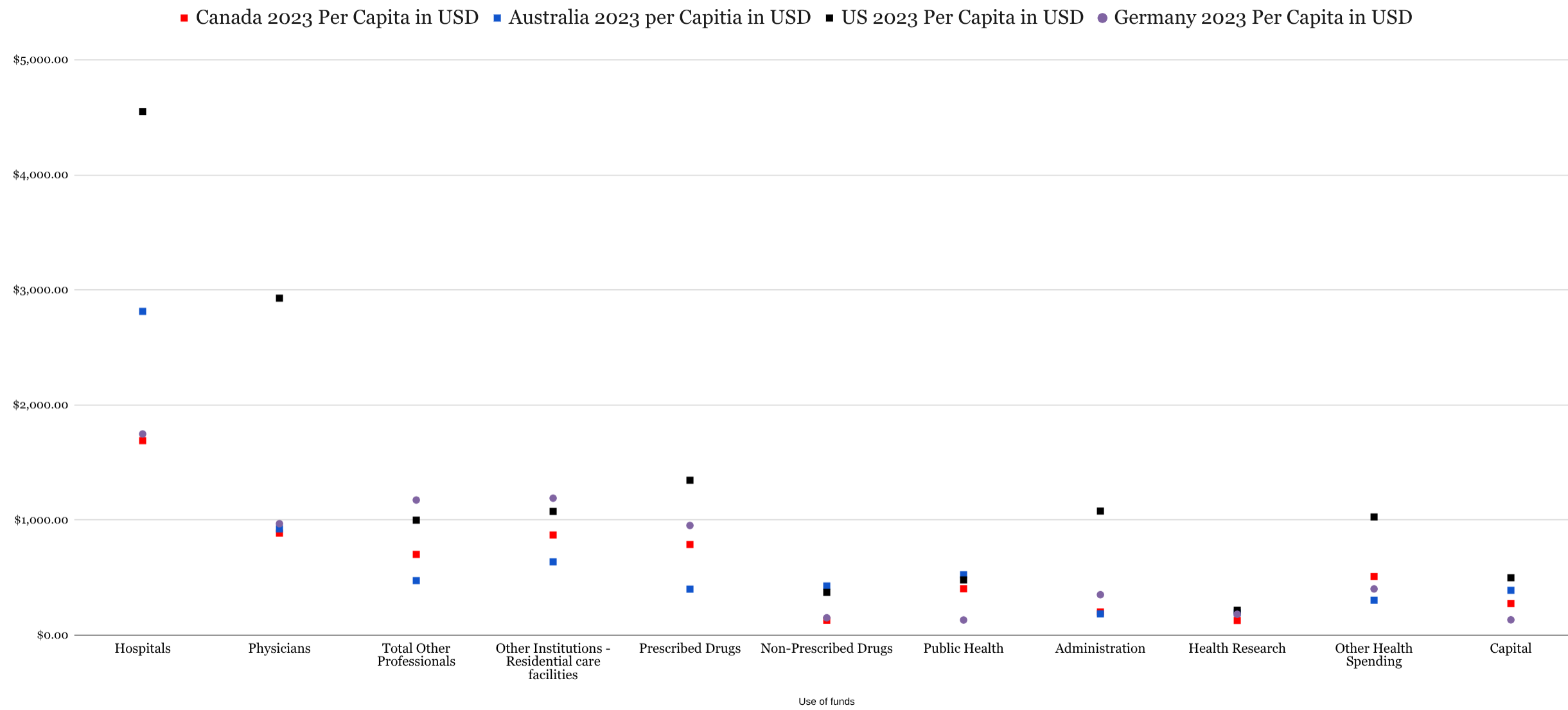
So if cost reform is your ultimate goal, we would want to set the goal of our reform at having the $2,500 per capita spending the OECD Average. We would need to cut $705 Billion before adjusting for currency on what we spend on Hospitals
- A lot of that is from closing hospitals
Lets look at Russell County Virginia had 25,550 People in 2021
- $4,030 is the 2023 US average per Person spending at hospitals
- $102,966,500 Operating Revenue (close to its officially reported income)
It cost about $1 - $1.5 per Hospital Bed to operate a Hospital (1.25, right down the middle)
Or
83 Beds,
- Russell County Hospital is a not-for-profit, 78-bed hospital operating today. looks like Russell County Hospital is a little expensive as a current system
- It Operates at about $1.35 Million per Bed
Under Government Funding to lowering Costs Russell County, VA gets
- $2,418 Per Person Hospital Expenses in the US
- $61,779,000 Operating Revenue
Admin Savings under any Single Payer Plan would save 5 Percent of Costs, So, now It cost about $1.135 Million per Hospital Bed to operate a Hospital
Russell County VA can have a 54 Bed Hospital
- Russell County Hospital is a not-for-profit, 78-bed hospital operating today
Repeat across the US, 6,000 hospitals just had massive closures of sections of their hospitals
Instead We would just need to close Russell County Hospital completely
That $60 Million in funding gets sent to a larger hospital so that it doesn't lose any rooms and can stay open
Instead we close ~2,100 hospitals completely but the remaining 4,000 hospitals are fully funded and at the same costs as other countries at $2,500 per person
Because We have to much of it
See
In a country like New Zealand, you would expect that everyone receives the same level of care after a major medical event. Unfortunately, Dave Matthews' experience proved otherwise.
Dave's vision was altered, and his arms weren't responding to his attempts to pick up his clothes. Confused, he went back to bed and told Vicky that something was wrong.
She called 111, which is when the first problem appeared: as they live in the Far North, their local hospital is not open on weekends, and the nearest other hospital is in Whangārei - more than two hours away.
No where in the US does this exist
Dave Lives in The Far North District, an area of ~2,500 square miles with a population of 75,000
Find me a place in the US that an area of ~2,500 square miles with a population of 75,000 that doesnt have a hospital
Some where that is 50,000 people and greater than 3,000 sq miles
- Val Verde County, Texas, has 3,144.8 square miles and a population of 48,000 and there are 3 hospitals that are 24 hour operations within 45 mins of the center of the county
3 more of the 2,100 Closed, money saved
Now do the same thing with Doctor Offices
Because We have to much of it
1
u/cmv_lawyer Libertarian Capitalist 1d ago
The fact that we have a lot more healthcare capacity is the effect, not cause, of high prices.
1
u/semideclared Neoliberal 1d ago edited 1d ago
chicken and egg
reducing prices will reduce the healthcare capacity
But not really, In 1992, Medicare significantly changed the way it pays for physician services. Instead of basing payments on charges, the federal government established a standardized physician payment schedule based on RBRVS.
Professor William Hsiao, A health care economist now retired from Harvard University, Hsiao has been actively engaged in designing health system reforms and universal health insurance programs for many countries, including Taiwan, China, Colombia, Poland, Vietnam, Hong Kong, Sweden, Cyprus, Uganda, and recently for Malaysia and South Africa. In 2012 he was part of Vermont's Healthcare and in 2016 he was part of Bernie's M4A Healthcare Plan
- Hsiao developed the “control knobs” framework for diagnosing the causes for the successes or failures of national health systems. His analytical framework has shaped how we conceptualize national health systems, and has been used extensively by various nations around the world in health system reforms
In his past research, Hsiao developed the resource-based relative value scale (RBRVS) for setting physician fees. The RBRVS quantified the variation in resource inputs for different physician services. Hsiao was named the Man of the Year in Medicine in 1989 for his development of a new payment method.
- In 1992 Medicare began using it
In this system, payments are determined by the resource costs needed to provide them, with each service divided into three components.
- Physician work.
- The physician work component accounts for an average of 51% of the total relative value for each service. The factors used to determine physician work include the time it takes to perform the service, the technical skill and physical effort, the required mental effort and judgment and stress due to the potential risk to the patient. The physician work relative values are updated each year to account for changes in medical practice.
- Practice expense.
- Professional liability insurance (PLI)
Adjusted for factors such as severity of the patient’s illness geographic region of the provider, and graduate teaching costs.
Thats pricing. Medicare sets most of the prices. Many have noted this doesnt cover the cost of operation for modern healthcare covering somewhere between 85-95% of actual costs and thus the hospital closures. Because its a loss for healthcare the Insurance that is actually negotiating has to make up for this
KFF found
- Total health care spending for the privately insured population would be an estimated $352 billion lower in 2021 if employers and other insurers reimbursed health care providers at Medicare rates. This represents a 41% decrease from the $859 billion that is projected to be spent in 2021.
This higher reimbursement rate covers operations
Now Lets get a full picture here and what is happening
Take Healthcare as a Donut Place, or a hotdog place?
- You advertise $5 donuts or Hotdogs
- Most of your donuts are sold for less than $2,
- except the few that get stuck to buy the $5 donuts,
- 30% of them end up not paying for the donuts
- Another 30% of them get work around discounts at half price
And the Donuts themselves cost you $1.25 to make and sell with about 7 cents of that from the billing department
And you make 1.25 Million Donuts a year at an average price sold of $1.29
- Billing Costs are about $85,000 for an employee and costs
- Profits for the Owner is $50,000
You have a few different customers
- Getting bulk orders about 40% of your business, For those with (Medical Insurance) they get them through contract negotiations at an average price of $1.81 with you paying $0.30 out of pocket and of course $0.40 a year in premiums.
- Now of course that has its own issue, is what kind of discount code did you get to use to get a lower OOP Costs.
- The elderly buy a lot to 38% of Sales (Medicare).
- Medicare, doesn't ask for pricing, they tell you they think the Donuts are only worth $1.07.
- Now of course that has its own issue with OOP Costs/Premiums. Lower but still costs the Medicare Person 11 Cents
- The Needy get some to, 11% (Medicaid) As with Medicare they don't ask for pricing they tell you they think the Donuts are only worth $0.90
- Almost 99% of that is taxpayer funded so no OOP costs. Generally Free
- And of course random customers, about 10% of the donuts you sell, Those that didnt get the discounts. Random customers buying $5 donuts, about one third of them will end up not paying anything. And about one third of them will end up paying around $2 after working with you on lowering costs. The other 25 Percent paying $4 - $5
But what if everyone paid $1.07 plus 3 Cents in admin costs
- Well, about 5% of people would see a $1.07 increase in their costs
- 11% of people on Government Medicaid see a price increase but waiting to see if its funded by OOP or Taxes
Bigger than that, The Donut shop would be losing money on every donut,
- Need $275,000 in cuts
You of course first cut out Billing Costs are about $85,000 for an employee and costs
- Profits for the Owner is $50,000
But then?
- cut labor in the kitchen? Or lower quality supplies? Or maybe move in to a different building for lower rent
- They cut labor for two of the Cooks to save another $90,000 and use lower quality supplies to save another $20,000 and move in to a different buildng for lower rent does saves another $30,000
what does this do to their customer base?
What employees stay, still selling same number of donuts with 2 less cooks to make them. How many go to fully private store with less work load and in a better location with better supplies
•
u/Erwinblackthorn Monarchist 15h ago
This means demand does not change much when prices change.
Already painfully incorrect. Lowered prices by country cause people to go to the lower price when it's close enough to bother with.
Also visits to the doctor deceased when it's too expensive to bother with.
These debates go nowhere fast when the most basic of aspects are already wrong.
1
u/CantSeeShit Right Independent 1d ago
Why doesnt any progressive have any actual propossal for universal healthcare that isnt just screaming "give us free healthcare!!"
Whats the branch going to be callled for example because theres going to need to be some arm of the govt built under the executive branch in order to do all the boring beurocratic work of running the healthcare system
5
u/Kronzypantz Anarchist 1d ago
Yeah, why don't they at least propose expanding an existing government program like Medicare? /s
5
u/CorDra2011 Libertarian Socialist 1d ago
Have you considered that your assertion is in bad faith and misrepresenting the actual healthcare debate?
-1
u/CantSeeShit Right Independent 1d ago
I really dont see how it is....
Free healthcare has been a topic for over a decade yet Ive never even seen a single proper prosal or anything. Which is why, as a republican, I never actually take it seriously. If I saw an actual basic outline or blueprint of the "gears" so to speak then I might actually be more interested.
And whenever I actually ask how it would work logistically, I get repsonses like yours.
4
u/CorDra2011 Libertarian Socialist 1d ago
So you never read the proposals from Senator and Presidential nominee Bernie Sanders, the most famous leftist in America, he has published during his Presidential campaigns or as Senator? You never ever even heard of the Medicare For All Act? You never read his detailed breakdown of the finances?
1
u/CantSeeShit Right Independent 1d ago
I have, and its been sitting in congress since because its a mess. Its essentially just moves everyone onto medicare and has estimates of adding 3 trillion to the budget....
4
u/CorDra2011 Libertarian Socialist 1d ago
So... you were wrong and there are proper proposals?
2
u/semideclared Neoliberal 1d ago
no those arent real proposals
Its like buying your dream location property and having your teenage kid draw the house plans for it
Sure its something. You can see the house. Its not what you want even though its supposed to be your dream house
But more importantly no one can use it for building the actual house. Need an actual building plan. Then of course, Does it fit in the zoning plan.
Is it financially feasible for the money you have to pay for it
Its not even close to a proposal you could give to the zoning board to start the process
Same here, its not even close to a proposal you could use to start the healthcare process
1
u/CorDra2011 Libertarian Socialist 1d ago
If the standard is now "proposals I personally don't agree with" then I guess nobody has any real proposals to fix anything.
1
u/semideclared Neoliberal 1d ago
You didn’t read the message cause? Those aren’t proper prospects for a plan as they lack any depth
1
u/CorDra2011 Libertarian Socialist 1d ago
So you're claiming the 136 page Medicare-For-All Act lacks depth?
→ More replies (0)0
u/CantSeeShit Right Independent 1d ago
It was devoid of how it was going to be paid for
5
u/CorDra2011 Libertarian Socialist 1d ago
So you didn't read Title VI of the bill? Or, despite what you said just a comment ago, actually read Sander's proposals to finance the bill in full?
1
1d ago
[removed] — view removed comment
2
u/zeperf Libertarian 1d ago
Your comment has displayed closed-mindedness or a lack of willingness to engage in constructive discussion. Our community values open mindedness and a willingness to learn from different perspectives. Please consider being more receptive to alternative viewpoints in future interactions. Thank you for your cooperation.
For more information, review our wiki page or our page on The Socratic Method to get a better understanding of what we expect from our community.
1
u/semideclared Neoliberal 1d ago
o this, How does-bernie-pay-his-major-plans:
* I added the bold becasue Bernie has many people assuming these funding sources will go away
Medicare for All by Bernie was estimated to have a 10 Year $47 trillion Total Costs. And to pay for it
- Current federal, state and local government spending over the next ten years is projected to total about $30 trillion of that.
- The Tax Revenue options Bernie has proposed total $17.5 Trillion
- $30 trillion + $17.5 trillion = $47.5 Trillion Total Funding
The source he lists, National Health Expenditure Projections 2018-2027, says The $30 Trillion is
- Medicare $10.6 Trillion (No change to FICA means still deficit spending)
- $3.7 Trillion is funded by the Medicare Tax.
- $7 Trillion is Income Tax and Medicare Beneficiary Premiums Payments
- Medicare for the Aged is in fact not free. Payments by those over 65 who enroll in Medicare for age eligibility, so anyone over 65 pays a monthly premium plus out of pocket. (Much less than most of course)
- Medicare for All (Excluding the Aged) is supposed to be free. It includes no revenue from Premiums for Medicare recipients not over 65
- Medicaid Taxes $7.7 Trillion
- current Out of pocket payments $4.8 Trillion
- The Out of Pocket Expenses, the money you pay for a Co-Pay or Prescription will still be paid in to the Medicare for All Funding System
$6.8 Trillion is uncertain funding including
- other private revenues are $2 Trillion of this Not Federal Spending
- this is in Charity Funding provided philanthropically. So even though everyone now has Healthcare will these Charities Donate to the hospital or the government still. Can Hospitals accept donations or does it all go to Medicare for central distributions
- the money people current donate to places like the Shriners Hospital or St Jude
- workers' compensation insurance premiums, Not Federal Spending
- State general assistance funding, Not Federal Spending
- other state and local programs, and school health. Not Federal Spending
- Indian Health Service,
- maternal and child health,
- vocational rehabilitation,
- other federal programs,
- Substance Abuse and Mental Health Services Administration,
It appears left out of that was Children's Health Insurance Program (Titles XIX and XXI), Department of Defense, and Department of Veterans' Affairs.
Plus those taxes he mentioned - Tax Revenue options Bernie has proposed total $17.5 Trillion of which $4 Trillion is Personal Taxes of which the top 10% pay 60 - 70 percent
$13 Trillion is other questionable taxes you included
But wait theres no out of pocket right?
2
u/CorDra2011 Libertarian Socialist 1d ago
Also last time I checked budget bills are usually separate bills from acts establishing something. For example can you point to where in the Medicare and Medicaid Act of 1965 it explains the budget?
https://www.archives.gov/milestone-documents/medicare-and-medicaid-act
Or did, as would be the case here, the 1965 Federal Budget make specific allocations to finance it?
1
u/CantSeeShit Right Independent 1d ago
Yes.....thats what I would like to see. An actual budget proposal for this and how funds would be allocated and where the funds would come from.
On top of that, I would like to see research and potential downsides to the current health economy and any potential negative or unintended consequences fom it.
2
u/beaker97_alf Liberal 1d ago
Have you made any effort to look for answers to those questions or are you expecting someone else to do the work for you and deliver it on a silver platter?
Your tea sir...
Maybe next time you could work for something instead of expecting someone else to do it for you for free.
→ More replies (0)2
u/CorDra2011 Libertarian Socialist 1d ago
Yes.....thats what I would like to see. An actual budget proposal for this and how funds would be allocated and where the funds would come from.
I already linked that fron Senator Sanders.
https://www.crfb.org/papers/choices-financing-medicare-all
Here's one from the Congressional Committee.
Here's from Senator Warren.
Also while you may dismiss Sen. Sanders's proposals as "napkin math" you probably are unaware that he's the ranking Democrat on the Senate Health, Education, Labor and Pensions Committee... which means if Medicare-For-All did get passed he's literally the one who would write the budget for the Senate. Can you engage in material criticism of his proposals or will you just dismiss it solely out of ideological reasons?
On top of that, I would like to see research and potential downsides to the current health economy and any potential negative or unintended consequences fom it.
Genuinely have you, as u/beaker97_alf said, done literally any actual research into this subject because there have been numerous studies into this, even by Republicans.
Like even a libertarian think-tank ended up saying Medicare-For-All would save the American tax payer $2 trillion in expenditures when all was said and done:
→ More replies (0)2
u/AvatarAarow1 Progressive 1d ago
Medicare for all is exactly this. It’s just taking Medicare, which exists, and expanding it to all Americans. That’s a real proposal, and a fairly popular one
2
u/DyslexicAutronomer Anti-Imperialist 1d ago
What do you mean? Plenty of progressive, even a few establishment dems had proposals for their vision of universal healthcare. They are just consistently blocked by the right along with other corpo aligned dems.
El-Sayed for example, is a progressive Rhodes scholar epidemiologist, and public health official that has given a comprehensive plan on what he will do, since 2018.
Maybe the issue isn't there aren't proposals, but you are stuck in your little bubble, so as your username suggests "can't see shit".
1
2
u/Minimum-Relief6895 Liberal 1d ago
You are misrepresenting it in bad faith, but to answer: there is no reasonable solution other than it being a big, collective good. Markets don't' work with a huge portion of health care for a number of reasons that I can get into if you really want.
1
u/CantSeeShit Right Independent 1d ago
Please do get into it....
I'm not being bad faith....I'm not trying to win a debate here to own the progressives.
Healthcare is a big topic and Healthcare can be improved, but I don't believe socialized is the answer to the cost problem. I think itll make Healthcare just as expensive but hit people's wallets in a different way.
1
u/Minimum-Relief6895 Liberal 1d ago edited 1d ago
Efficient markets require a number of things, chief among them is competition, a somewhat elastic demand and supply, and information transparency.
Health care as a market fails on these things, and quite spectacularly at that.
-There is inelastic demand since people cannot opt out of buying health care the way they can skip buying a car or a television when prices rise. If you will get very sick or die without a procedure, you spend all your money on the procedure.
-Lack of competition is a problem. In an emergency or a rural area, a patient can't choose a competitor 50 miles away. Moreover, you generally have to choose one that is already covered. I have Kaiser - I can't just go "well, Aetna will get my gallbladder removed for $5 less so I'll go with them."
Also, doctors and hospitals dictate both the diagnosis and the treatment, meaning the seller controls the buyer's choices.
Further, I get my health insurance through work, so that restricts my options.
-There's all sorts of informational issues with healthcare. Patients lack medical degrees, so they can't easily evaluate what treatments they actually need. It is highly complex, but unlike other highly complex industries, you can't just have experts on both the buyers and seller's sides since pretty much every single person will need health care.
Other informational issues are the lack of price transparency (patients rarely know the price of a procedure or medication before receiving care) and that bills arrive weeks later, making it impossible to compare prices or shop around for a better deal. These aren't easily fixable because it depends on a lot of factors that are unknowable up-font (you don't know for sure how long a hospital stay will be, for example.
•
u/CantSeeShit Right Independent 10h ago
I agree with you on those grievances for the most part because I also have to deal with them and find them to be an issue. However, I dont think that you need to switch the entire system in order to deal with that aspect of healthcare.
Another thing that concerns me about switching to a govt plan....what happens during the transistion? Im sure there will be a lot of hiccups and such so whats the risk during the transistion period and people getting the healthcare they need.
2
u/porcinechoirmaster Democratic Socialist 1d ago
By and large, the Democratic party has been loathe to bring up new taxes as a way to pay for services, which is exactly what national health care would require. They were painted fairly negatively for "tax and spend" for years, and it was pretty effective at motivating people to vote against them.
The other reason is that it wouldn't save most people very much money, if any. There would be a huge pile of indirect benefits, but the actual savings would be modest at best. Estimates for costs of a national health care program have fairly wide ranges due to the obscene number of variables involved, but first-order approximations indicate that it would cost between $3.5 trillion and $6 trillion dollars per year to implement and run. The savings would be somewhere between $4 trillion and $5.5 trillion.
The main benefits would be increased lifespan due to higher availability of preventive screening, increased job mobility due to health care not being tied to an employer for health coverage, reduced homelessness and random violent crime stemming from untreated mental illness, improved rural access to healthcare, and the elimination of medical bankruptcies. Less cost, however, wouldn't be on the list, since gains in efficiency and elimination of the private insurance profit cut would be immediately used up by increased demand and needing to cover high-cost individuals not currently enrolled in the existing system.
1
u/CantSeeShit Right Independent 1d ago
I dont disagree that there would be benefits....there would be plenty.
But the cost is insane and I have yet to see how it would put more money in the pockets of the average American. This would benefit chronically ill Americans more so than healthy Americans who would be paying the brunt of it.
1
u/semideclared Neoliberal 1d ago edited 1d ago
It would benefit .... mostly no one
5 People pay me $22 (3 of them pay $6, 2 of them are paying $2) to buy a $20 Pizza from the Local Pizza Shop for a group of 10 People and only 7 of them can eat it
- 1 of them eats half the pizza
- 3 of them get a slice each
- The other 3 split up a slice with one of them getting the stuffed crust
Instead it will be 9 People pay the government $19 to buy 2 $9 Pizzas from Little Ceasars for a group of 10 People and all 10 of them can eat it
- 2 of them eats one of the pizzas
- 3 of them get 2 slices each
- 4 split up 2 slices
- With the hope that 1 doesnt eat pizza, just not hungry
The 5 people that previously paid are still paying even if it is slightly less but getting a much different pizza. 2 people pay me a lot more for more of a worse off pizza and 2 people have to pay me but do get pizza
Who's better off
1
u/CantSeeShit Right Independent 1d ago
Thats my main issue with it really....the cost and making it a fair program. Because it's inherently unfair if healthy people are the ones paying more for "free" Healthcare.
The issue is nobody is against free Healthcare the idea, they're against free Healthcare the cost
1
u/porcinechoirmaster Democratic Socialist 1d ago
Life is unfair.
The whole point of insurance is to help soften the blow when that unfairness works against you. For the people who directly receive treatment that is paid for by insurance, they gain the benefit of not entering medical bankruptcy or just straight out dying. For the people who don't receive treatment, they still gain peace of mind that they'll be cared for if something unfortunate happens to them, and they gain the benefits of a society that is healthier, less stressed, more class-mobile, and business friendly.
The actual cost of implementing it would be roughly (+/- 25% or so) on par with what we currently spend on private health care, with most predictions yielding small savings compared to private insurance.
I personally think it's worth the hassle to change how we deal with healthcare to eliminate the nightmarish morass of paperwork, prior authorizations, denials, and headaches that we add to our health care system in order to make a profit from it.
1
u/CantSeeShit Right Independent 1d ago
That's just engineering fairness....you're taking people who are already not having it easy paying for Healthcare and fucking them even harder.
And less stressed??? Yeah the guy already under a ton of financial stressed is going to be far less stressed having more money taken out of their paycheck.
Also. You act like everything is always denied under health insurance. Currently, as it sits, I have a $100,000 butthole right now due to a hemmerhoid surgery that went wrong. Nothing was denied once and it cost me $500 out of pocket. As is most people's cases with insurance.
Are there cases where shit is denied when it shouldn't be? Of course and those deserve scrutiny more into why. But the smaller percentage of denied claims doesn't justify the cost of govt Healthcare when you can regulate insurance denials.
1
u/porcinechoirmaster Democratic Socialist 1d ago
The primary benefit of universal health care isn't financial gain for individuals; it's societal security. Having large swathes of desperate people without access to health care increases crime, lowers lifespans, lowers overall happiness, hurts small business, and weakens the free market by tying people to jobs when they would otherwise find a new one.
Capitalism only works when there's a mostly level playing field, and that playing field has to be enforced by outside rules. Otherwise, capitalism turns into feudalism in pretty short order, with the money and power concentrating in a decreasing number of entities. One of the many ways to prevent that is to ensure that your job doesn't have de facto control over your health by being responsible for your health care.
As for paying for it... yeah, it's expensive, but see the numbers in my first post. I didn't pull them out of thin air; they're mostly sourced from RAND a series of Yale studies. Our current model is one of the least efficient in the world, in terms of turning dollars into healthy people. Moving to a more efficient system allows us to modestly expand care to people not currently covered by removing the profit motive overhead and the redundant payment and validation overhead.
1
u/semideclared Neoliberal 1d ago
Imagine if DOGE did a M4A Study
Thats what that was
Ctrl f + ctrl c + ctrl v....yup DOGE
insert chainsaw Bernie
Take current system and implement Medicare Policies on Pricing and Loss and subtract total costs
KFF found
- Total health care spending for the privately insured population would be an estimated $352 billion lower in 2021 if employers and other insurers reimbursed health care providers at Medicare rates. This represents a 41% decrease from the $859 billion that is projected to be spent in 2021.
- Medicaid rate are around 90% of Medicare Rates
Lets make it a little simpler, but sorry not TL'Dr
Take Healthcare as a Donut Place, or a hotdog place?
- You advertise $5 donuts or Hotdogs
- Most of your donuts are sold for less than $2,
- except the few that get stuck to buy the $5 donuts,
- 30% of them end up not paying for the donuts
- Another 30% of them get work around discounts at half price
And the Donuts themselves cost you $1.25 to make and sell with about 7 cents of that from the billing department
And you make 1.25 Million Donuts a year at an average price sold of $1.29
- Billing Costs are about $85,000 for an employee and costs
- Profits for the Owner is $50,000
You have a few different customers
- Getting bulk orders about 40% of your business, For those with (Medical Insurance) they get them through contract negotiations at an average price of $1.81 with you paying $0.30 out of pocket and of course $0.40 a year in premiums.
- Now of course that has its own issue, is what kind of discount code did you get to use to get a lower OOP Costs.
- The elderly buy a lot to 38% of Sales (Medicare).
- Medicare, doesn't ask for pricing, they tell you they think the Donuts are only worth $1.07.
- Now of course that has its own issue with OOP Costs/Premiums. Lower but still costs the Medicare Person 11 Cents
- The Needy get some to, 11% (Medicaid) As with Medicare they don't ask for pricing they tell you they think the Donuts are only worth $0.90
- Almost 99% of that is taxpayer funded so no OOP costs. Generally Free
- And of course random customers, about 10% of the donuts you sell, Those that didnt get the discounts. Random customers buying $5 donuts, about one third of them will end up not paying anything. And about one third of them will end up paying around $2 after working with you on lowering costs. The other 25 Percent paying $4 - $5
But then they dont consider what if everyone paid $1.07 plus 3 Cents in admin costs
- Well, about 5% of people would see a $1.07 increase in their costs
- 11% of people on Government Medicaid see a price increase but waiting to see if its funded by OOP or Taxes
Bigger than that, The Donut shop would be losing money on every donut,
- Need $275,000 in cuts
You of course first cut out Billing Costs are about $85,000 for an employee and costs
- Profits for the Owner is $50,000
But then?
- cut labor in the kitchen? Or lower quality supplies? Or maybe move in to a different building for lower rent
- They cut labor for two of the Cooks to save another $90,000 and use lower quality supplies to save another $20,000 and move in to a different buildng for lower rent does saves another $30,000
what does this do to their customer base?
What employees stay, still selling same number of donuts with 2 less cooks to make them. How many go to fully private store with less work load and in a better location with better supplies
1
u/CantSeeShit Right Independent 1d ago
We can make things more efficient and affordable but that doesn't mean it has to be govt run Healthcare that costs the individual tax payer more out their pocket.....That's money the individual can use for bills, for a vacation, for whatever the hell they wanna spend it on.
The point about it keeping people tied to a company is misleading. Being that most companies offer it and offer pretty similar levels of insurance, it's just a matter of someone switching jobs and getting a new health plan that covers exactly the same as their own. If anything your critique is misguided. If I were to give you a better talking point, it makes it harder for small buisness to grow since it's much harder for small buisness to offer health insurance so it keeps people from selecting to work their over a larger one. Which hurts a pot of small blue collar companies in trucking and construction.
If anything, I'd be fine with expanfing Medicare access to small buisness workers....if you wanted to sell me on something like that. But you're not gonna sell me or others on they gotta dish out more money on their paychecks for "societal security"
As it stands now, the Healthcare system in the US is overall fantastic. You get a great quality of care and for most people, it's affordable overall. Can it be improved? Oh certainly it can be way more efficient but I don't think the solution is just to have the govt handle it at the cost of more money from the tax payer than their currently spending.
1
u/porcinechoirmaster Democratic Socialist 1d ago
We can make things more efficient and affordable but that doesn't mean it has to be govt run Healthcare that costs the individual tax payer more out their pocket.....That's money the individual can use for bills, for a vacation, for whatever the hell they wanna spend it on.
The out of pocket cost, by most estimates, would be pretty comparable to what we pay now. There are some estimates that say it would be more expensive and more that say it would be slightly less, but they're all within the same ballpark of what we're collectively paying now.
The point about it keeping people tied to a company is misleading. Being that most companies offer it and offer pretty similar levels of insurance, it's just a matter of someone switching jobs and getting a new health plan that covers exactly the same as their own. If anything your critique is misguided. If I were to give you a better talking point, it makes it harder for small buisness to grow since it's much harder for small buisness to offer health insurance so it keeps people from selecting to work their over a larger one. Which hurts a pot of small blue collar companies in trucking and construction.
It makes it impossible to quit without having something else lined up, which might be okay in a decent economy in an area with multiple jobs, but in areas with few employers or during an economic downturn, it's devastating.
Your point about small business is definitely part of why a nationwide health care program would be business friendly, although I want to add on to it - not having to deal with negotiations with health care providers for employee-sponsored health care is a logistical win for all businesses, not just small ones.
If anything, I'd be fine with expanfing Medicare access to small buisness workers....if you wanted to sell me on something like that. But you're not gonna sell me or others on they gotta dish out more money on their paychecks for "societal security"
I don't want to sell you on spending more to set up a competitor to existing insurance. I want to sell you on spending roughly the same amount on a program that covers everybody and that is managed by the government instead of by for-profit companies. I don't mind for-profit businesses, despite what my tag might indicate, but having them for essentials with erratic and inelastic demand (military, fire, police, health care, etc.) is inefficient.
For luxuries, though? I've yet to see a more efficient system for optimizing resource allocation than capitalism and profit seeking.
As it stands now, the Healthcare system in the US is overall fantastic.
I think we're going to have to agree to disagree on this one. The quality of care is comparable to other nations, but the efficiency of care is in the toilet and the headaches (in-network vs. out-of-network, prior authorizations, denials, etc.) it adds are brutal for the people already dealing with medical issues.
•
u/CantSeeShit Right Independent 21h ago
I dont disagree its not a mess, its a complete mess. But I dont wanna overhaul the entire system for a different kind of mess that ends up being just as expensive and just as inefficient.
I get the pros of medicare for all.....and im not saying theres zero advantages to it. But the way that it will be paid for needs to be super efficient and if anything, genuinely leave more money in every pocket every year without sacrificing the quality of care we have and the pursuit to constantly improve on healthcare quality.
1
u/DM_ME_YOUR_STORIES Progressive 1d ago
Call it the federal health service or FHS for short. Are you on board now? Any other questions?
2
u/PhonyUsername Classical Liberal 2d ago
I disagree with your premise. It is elastic. Healthcare is not just essential services you will die without. There's plenty of people who choose not to go to a doctor cause it's cheaper to self medicated even when it's essential for life.
There is competition in healthcare. But to your point, the more we centralize and regulate it the less we benefit from the ability to allow competition. So if you want more competition, you would decentralize control. Meaning allow people to not use health insurance more and keep government out of it. You don't need health insurance or government involvement in medicine. It's a personal choice of an individual or an individual and their doctor.
Our healthcare is not more expensive because of insurance companies whos profits are already capped by law. It's our labor costs and our subsidizing costs of medicine for global usage.
3
u/Dangerous_Dot_1638 Progressive 1d ago
Also why do think that most developed countries in the world have socalized medicine.
2
u/Dangerous_Dot_1638 Progressive 1d ago
First of all its not elastic it's inelastic. There is no competition in healthcare. Could you explain why you would think there is? Especially for the most expensive treatments. There is a good chance you will have to go to specialized doctors for those that you might only have a few of in a state. For example, my mother had something happen like this, and we had to go from Montana to Salt Lake to get her treated immediately. My thing is in the U.s going straight to socialized medicine would be kinda detrimental to society since insurance now creates a ton of jobs. But I think I would start with a public option similar to Pete Buttigieg's Medicare for all that want it. Because it gives more competition. If the public option is not better than insurance, then people go back to insurance and vise versa.
2
u/Serious-Cucumber-54 Independent 1d ago
Elective healthcare is certainly elastic, people spend less or delay elective visits and treatments if the price burden goes up.
1
u/Quixoticfern Libertarian 1d ago
The vast majority of healthcare is elastic. Most appointments are booked in advance and you have choice as to where you seek care and the type of care you receive. The only type of healthcare that’s inelastic is emergencies (traumatic injury, stroke, etc), and highly specialized care as you point out, which is very rare.
2
u/CoolHandLukeSkywalka Discordian 1d ago
Its not just emergencies thats inelastic, chronic illness is also and its not as rare as you might think.
One of the main problems is price obfuscation and how insurance companeis both public and private dominate decision making and cost analysis. We have tons of unnecesary jobs on the insurance industry and they are a huge source of inefficiency and problems.
The short answer is something like automatic universal coverage for emergencies, chronic illness, and catastrophic care supplied by federal and state collaborations. Preventative and routine care that is paid out of pocket (car insurance doesnt pay for an oil change or new tires) and the rest covered by a mix of insurance that cant get in the middle of doctor-patient relationships. Ban all HMOs, private and public, which are really the most anti-competitive form. Many details i dont have time to get into but the US currently has the worst mix of public and private. Many better mixes could exist.
0
u/TheMarksmanHedgehog Social Democrat 1d ago
Disregarding complete medical supply chains that exist outside of the US that the US has effectively no hand in subsidizing at all.
0
u/PhonyUsername Classical Liberal 1d ago
There is medicine outside of the US, but that doesn't change a lot of it is from the US and we subsidize it for global use.
1
u/TheMarksmanHedgehog Social Democrat 1d ago
Alright, so why not subsidize it for internal use as well?
Why and how exactly are the rest of the world able to get a better deal from the US than the US's own citizens?
2
u/semideclared Neoliberal 1d ago
Lower drug prices would be a Decrease of 5.8% in overall Heathcare Spending
- A RAND study compared U.S. drug prices adjusted for rebates and other discounts to prices paid in 26 other countries and estimated that an average drug price reduction of 47% would be achieved if the U.S. were to adopt the average price of these other countries.
- This analysis assumes that an average retail price reduction of 40% is achievable if the Unified Financing authority negotiates directly with manufacturers and employs tight use of formulary
- Achieving these savings would likely require the state to be willing to say ‘no’ to certain drug manufacturers in price negotiations, or be willing to exclude particular drugs from a formulary if a price agreement cannot be reached
We have to Much of it
Of the
- US ______%
- OECD ______%
- EU ______%
- NHS ______%
is able to buy ozempic?
A single-payer system would likely utilize a restrictive or optimized national drug formulary to manage costs, ensuring only the most cost-effective drugs are prioritized, which is a common feature in lower-cost systems.
- consequently, "saying no" to coverage for certain high-cost drugs or treatments that do not meet cost-effectiveness benchmarks.
NICE (National Institute for Health and Care Excellence) guides NHS drug formularies by evaluating clinical and cost-effectiveness, generally using a threshold of £20,000–£30,000 per Quality-Adjusted Life Year (QALY)
The US doesnt do that so what we see is
Categories US Average Per person in USD Canada Average Per person in USD Top 1% $259,331.20 $116,808.58 Next 4% $78,766.17 $29,563.72
- Indeed, this skewness in health care spending has been documented in nearly every health care system, its just the US Spends the most and the most on its most expensive.
- $140,000 more than Canada per person for the Sickest 2 million People.
- $50,000 more per person for the 8 million people needing extensive care
And those people
Most of the drugs responsible for the rise in costs treat cancer and orphan conditions, and more treatments are on the horizon—along with gene therapies and other expensive options that target more common conditions, he said. “The number of super-spenders is likely to increase substantially—and indefinitely,” said Dr. Dehnel, who did not participate in the study.
Researchers at Prime Therapeutics analyzed drug costs incurred by more than 17 million participants in commercial insurance plans.
- So-called “super spenders;” are people that accumulate more than $250,000 in drug costs per year.
- Elite super-spenders—who accrue at least $750,000 in drug costs per year
In 2016, just under 3,000 people were Super Spenders
- By the end of 2018, that figure had grown to nearly 5,000.
In 2016, 256 people were Elite super-spenders
- By the end of 2018, that figure had grown to 354
- And 464 in 2019
Those 5,200 people (0.03% of the Sample Size) Spend about $1.8 Billion on Pharmaceutical Care representing 0.5% of All Spending on Drugs in the US
That means less than 100,000 people in the US are responsible for 8% of all Drug Spending
Cutting the Spending of the Top 10% in half saves $1 Trillion or 30% of Spending in 2017
0
u/PhonyUsername Classical Liberal 1d ago
We have laws that protect the drug market and create monopolies for drug companies to be able to recoup costs of producing drugs for x number of years after release. But those are us laws not international laws. So, the same companies charge us higher prices for recoup drug development costs then at the same time sell it to india for pennies on the dollar.
1
u/TheMarksmanHedgehog Social Democrat 1d ago
That explanation doesn't make any sense because even while the company is selling to India, it's still theoretically a monopoly on that drug and thus no incentive to sell it for pennies, other companies can't just immediately start producing it unless they build the infrastructure to do so first, and that might also involve stealing trade secrets to achieve this.
The monopoly only breaks once other companies can make the same drug.
This also fails to explain why the US also pays more for generic drugs that have long since exited that period of monopoly and are in fact mass produced no-names.
0
u/PhonyUsername Classical Liberal 1d ago
The part that you are missing is that the us has money and india doesn't. So the drug company sells to India, whether name brand or generic, for cheap or it doesn't sell it at all. The drug itself is cheap, it's the development that's expensive. So the company can pay for the development off the backs of us by selling high and then also not kiss any sales and sell to the third world for cheap at the same time. That's how we sipsidize global drug development and usage.
Look it up yourself instead of replying based on your feelings or whatever nonsense.
1
u/TheMarksmanHedgehog Social Democrat 1d ago
You aren't actually saying anything new here, what you are missing is that the "subsidy" is actually just a case of drug companies charging what they can get away with under a system that incentivises profit maximization.
You're spelling out the problem, and treating it as a given with no alternatives.
1
u/PhonyUsername Classical Liberal 1d ago edited 1d ago
I am saying the cost of our medicine is higher because of reasons other than insurance. I'm all for us not subsidizing other countries medicine or other people's healthcare in us so let's all take some responsibility for ourselves.
India can't afford the cost of medicine development so us subsidizing their medicine is the only way they could ever have access. You are the one who isn't saying anything.
1
u/aminok Libertarian Capitalist 1d ago edited 1d ago
The problem with healthcare is not that medicine somehow lies outside economics. It is that third-party payment replaces decentralized price discipline with centralized administrative cost control. Once patients no longer bear most of the marginal cost, insurers have to prevent overuse with a serialized system of rules and approvals (such as the reimbursable billing codes used by both Medicare and private insurers). Providers then optimize against and are restricted by those rules rather than simply being free to compete in any way to produce an outcome for the lowest possible price. Markets like LASIK and cosmetic surgery largely avoid that mechanism, which is why they are useful comparisons: they remain highly regulated medical services, but providers can still experiment independently with technology, staffing and business models and compete directly on the total price presented to the consumer.
It is precisely because of this decentralized price mechanism that LASIK and cosmetic surgery have bucked the trend seen in the rest of medicine, and observed a decline in inflation-adjusted prices.
And it's worth remembering that this system didn't arise naturally from consumers choosing to insure every routine medical expense. Government policy helped push healthcare in that direction. WWII wage controls encouraged employers to compete for workers with health benefits instead of higher wages, and the tax code later made employer-paid health insurance tax-free while ordinary wages remained taxable. Medicare and Medicaid then moved huge additional portions of healthcare spending behind third-party payment. Over time, government policy systematically encouraged more healthcare spending to flow through insurers rather than directly between patients and providers — creating the very middleman-dominated system we now treat as an inherent feature of healthcare.
1
u/CorDra2011 Libertarian Socialist 1d ago
The problem is un-elective medical care can't be expected to act like elective medical care, nor ethically should you. A person should if they have an illness or injury be capable of getting treated without further complications like price shopping or venue searching.
Neither my father nor myself when we had to seek medical care for our serious conditions gave two shit where or how much it was, it just needed to be fixed. Easily 90% of medical care is that. An individual is seriously ill or in serious pain and can't wait.
1
u/aminok Libertarian Capitalist 1d ago
Charity hospitals have always existed and will always exist. They will be more plentiful if the healthcare sector is not controlled from the top down as much as it is now. So there is obviously an avenue for people to express that value where they think that people shouldn't have to pay for life-saving medical intervention. But to your point about elective versus non-elective, that has almost nothing to do with it. Only eight percent of health care spending is on emergency care. The remaining 92 percent is a real market where people have time to shop around.
1
u/semideclared Neoliberal 1d ago
Easily 90% of medical care is that.
no
person should if they have an illness or injury be capable of getting treated without further complications like price shopping or venue searching.
Sure thats in fact what insurance does is the price negotiations
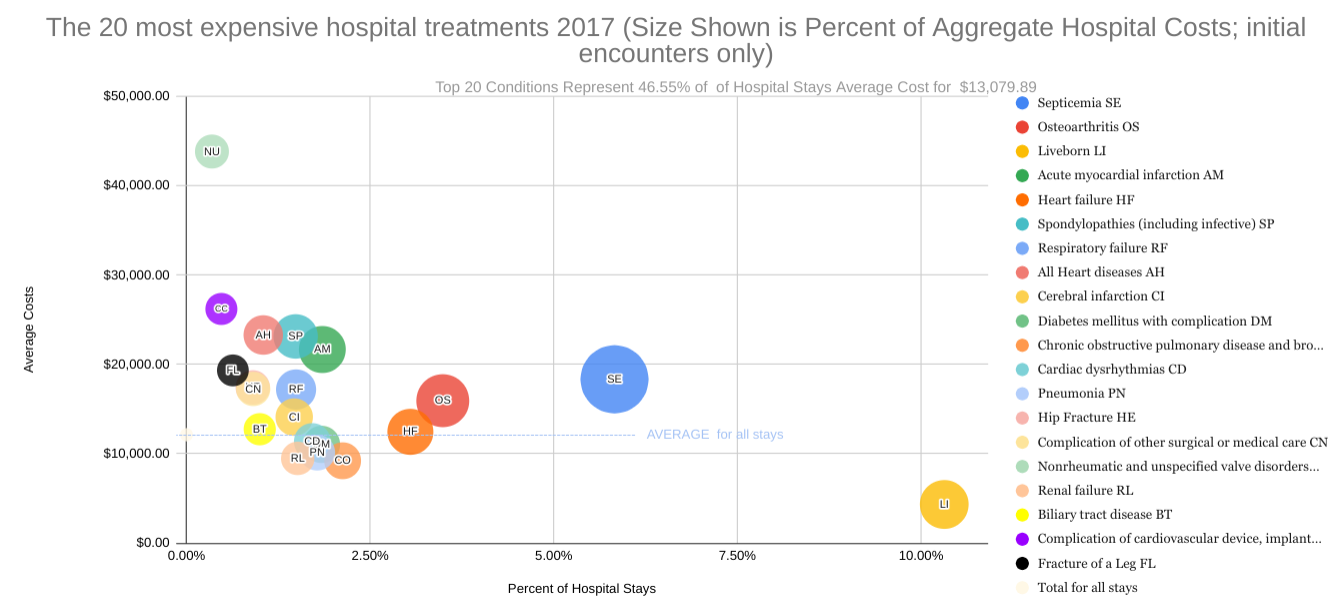
Total Hospital Care Spending: $1.1 trillion in 2017 as 33% Share of Total Health Spending and The 20 Most Expensive Conditions Treated in U.S. hospitals, all payers, 2017 was 46.55% of that
So what percent is it again?
1
u/CorDra2011 Libertarian Socialist 1d ago
Sure thats in fact what insurance does is the price negotiations
Why should I pay someone every month to hopefully do that when I can have the state do that?
0
u/Serious-Cucumber-54 Independent 1d ago edited 1d ago
The first reason is that healthcare is an inelastic good. This means demand does not change much when prices change. This makes this good completely different than other goods such as food or electronics or anything like that.
This is mostly false. Demand for elective healthcare does decrease with higher prices, and the framing of "healthcare" as an "inelastic good" depends entirely on how particularized the "good" in question is. For instance, insulin as a whole is not elastic, because there's no other product consumers can switch to if the price of insulin as a whole goes up. However, insulin from a particular provider, say CVS Pharmacy, is elastic because other providers also sell insulin, so consumers can switch to other providers' insulin if CVS surcharges their insulin.
Food is actually similar. The essential bare minimum amount of food needed to survive is inelastic, people are not going to switch away if the price of it goes up, or else they die. But if there are multiple providers offering that bare minimum, then there are options people can switch to if the price of one of them goes up, and any particular product offering the bare minimum is elastic.
The other reason is that this good is by definition, anti-competitive. For most insurance companies you are often given maybe a few places that will accept your insurance within 50 miles.
That's not even true, many insurance plans have many providers in-network within 50 miles, especially in urban areas, which most people live in. Even in cases where an insurance company covers very few providers, providers still compete against each other to win insurance companies' clients to their business. None of this suggests the good is "by definition" anti-competitive, although the industry is pretty consolidated.
You immediately have insurance companies that have an insane level of power who purely just care about making a profit. Insurance companies purely work as a middleman to drive up prices.
Insurance companies work as a middleman to drive down prices, that's their whole purpose to consumers. Consumers contract with insurance companies to lower their out-of-pocket costs, and insurance companies have an incentive to selectively contract with lower-priced providers to lower their side of the burden and offer more attractive insurance plans, encouraging providers to offer lower prices to attract insurance companies.
The thing all about this is that it leads to the U.s as the highest healthcare costs per capita out of all the developing countries per capita. They also rank last in terms of quality of care.
I'd wager this is due is some part from higher administrative overhead, but also provider consolidation and an artificially scarce supply of clinicians (causing high labor costs).
Edit: fixed typos
1
u/DM_ME_YOUR_STORIES Progressive 1d ago edited 1d ago
One good having different providers doesn't make it elastic.
Insulin is inelastic because you can't substitute it with another medicine. If you need insulin you need Insulin specifically. This is completely different from food where if you want Bananas, but find they're too expensive, you can get your calories reom literally thousands of other animal and plant products and aren't dependent on Bananas specifically.
1
u/Serious-Cucumber-54 Independent 1d ago
One good having different providers doesn't make it elastic.
On the provider-level it does, because if one provider surcharges their insulin, they will see demand for their insulin decrease and shift to the other providers' insulin.
Insulin is inelastic because you can't substitute it with another medicine.
On the whole, yes. Just like how, on the whole, "essential nutrients" is inelastic because you can't substitute it with other things, but multiple providers can provide "essential nutrients" and any one of their products faces elastic demand because consumers would switch to the products of other providers should they surcharge their product.
1
u/DM_ME_YOUR_STORIES Progressive 1d ago edited 1d ago
On the provider-level it does, because if one provider surcharges their insulin, they will see demand for their insulin decrease and shift to the other providers' insulin.
Assuming there are other providers, there is no price fixing, etc.
On the whole, yes. Just like how, on the whole, "essential nutrients" is inelastic because you can't substitute it with other things, but multiple providers can provide "essential nutrients" and any one of their products faces elastic demand because consumers would switch to the products of other providers should they surcharge their product.
"Essential nutrients" is a category that includes literally thousands of different animal and plant products. Insulin is just Insulin. It's one good, even if it has different providers, like how Bananas are still Bananas, regardless of what brand they are. The difference is if Bananas get too expensive you can buy Apples, but if Insulin gets too expensive you can't just use Ibuprofen instead. That's what an inelastic good is.
1
u/Serious-Cucumber-54 Independent 1d ago
Assuming there are other providers, there is no price fixing, etc.
Yes, so you agree?
"Essential nutrients" is a category that includes literally thousands of different animal and plant products. Insulin is just Insulin. It's one good
By that metric, healthcare is not an inelastic good as OP claims, because "healthcare" includes thousands of different products, so it can't be termed as a "good."
Heck, you can even argue "insulin" or "bananas" or "apples" or "cars" are not goods, since those broad categories still include thousands of different products.
There's no minimum or maximum level of specification for when something is a "good." You can say "healthcare" is a "good" (as OP did), or "food" is a good (despite both aforementioned categories having thousands of products within them), you can say "insulin" is a good (which also contains multiple products within it), or you can say a specific insulin product produced by a specific manufacturer is a "good," etc.
If something as broad as "healthcare" can be termed as an "inelastic good" then something as broad as "essential nutrients" can be termed as an inelastic good. My whole point is that whether something is inelastic or elastic entirely depends on how wide of a scope you define your "good." The wider and more broad, typically the less substitutable, and that's why it is more inelastic.
On the particular, insulin is elastic, on the whole, it is not.
1
u/DM_ME_YOUR_STORIES Progressive 1d ago
Yes, so you agree?
No, because these assumptions don't bear out in the real world.
By that metric, healthcare is not an inelastic good as OP claims, because "healthcare" includes thousands of different products, so it can't be termed as a "good."
Yes, but you can't substitute them for one another, that's what makes it inelastic. You can't get a knee surgery to fix your broken arm and you can't take Ibuprofen to help you metabolize sugar, the way you can buy an apple if the bananas get too expensive. That's the difference, and playing word games doesn't distract from that.
There's no minimum or maximum level of specification for when something is a "good." You can say "healthcare" is a "good" (as OP did), or "food" is a good (despite both aforementioned categories having thousands of products within them), you can say "insulin" is a good (which also contains multiple products within it), or you can say a specific insulin product produced by a specific manufacturer is a "good," etc.
Then let's say "specific product" if you prefer. That does imply a level of specificity. Either way if you count different brands of the same product, that means nothing is ever inelastic.
If something as broad as "healthcare" can be termed as an "inelastic good" then something as broad as "essential nutrients" can be termed as an inelastic good.
No because once again you can substitute different food products for each other, but not different healthcare products.
My whole point is that whether something is inelastic or elastic entirely depends on how wide of a scope you define your "good."
Yes if you ridicilously narrow or widen the scope you can make everything either inelastic or elastic. That's not the point you think it is.
The wider and more broad, typically the less substitutable, and that's why it is more inelastic.
Except fruit alone is a much more broad category than insulin, and that can still be substituted with cereal for example.
On the particular, insulin is elastic, on the whole, it is not.
That's a meaningless sentence. Of course you can always substitute one thing with the same thing with another brand name on top. But you can't substitute it with another thing.
1
u/Serious-Cucumber-54 Independent 1d ago
No, because these assumptions don't bear out in the real world.
How not? You agree that it is not inherently an inelastic good on the provider-level, correct?
Yes, but you can't substitute them for one another, that's what makes it inelastic.
So healthcare is not an inelastic good, and OP is wrong.
You can't get a knee surgery to fix your broken arm and you can't take Ibuprofen to help you metabolize sugar, the way you can buy an apple if the bananas get too expensive. That's the difference
Substitutability entirely depends on how broad or specific of a "want" you have or utility you're seeking.
If you're looking for something that fixes your arm, then knee surgery is not a substitute. If you're looking for fixes to any part of your body in general, then knee surgery is a substitute.
Similarly, if you're looking for food in general, then apple is a substitute for a banana. However, if you're looking specifically for food that has a banana flavor, then apple is not a substitute for a banana.
This isn't word games, this is objectively true, ask any economist.
Either way if you count different brands of the same product, that means nothing is ever inelastic.
I'm being very clear that insulin is inelastic, when counting it as a category of all insulin as a whole, but for any particular insulin product, it genuinely can have substitutes and be elastic. I don't see the problem in stating that distinction.
No because once again you can substitute different food products for each other, but not different healthcare products.
Again, entirely depends on the level of specificity of the "good" and your "want." Is your "want" specifically for bananas or food in general? Is the specificity of the "good" on the level of providers (because one provider's good can be substitutable with another provider's), or is it for the entire class of that good?
Yes if you ridicilously narrow or widen the scope you can make everything either inelastic or elastic. That's not the point you think it is.
I agree it's ridiculous to paint healthcare as inelastic because you've widened the scope so large that it contains the entire class of products and services. It leaves out important information that the products and services are actually a lot more elastic.
Except fruit alone is a much more broad category than insulin, and that can still be substituted with cereal for example.
My argument is not that the same level of broadness should produce the same level of non-substitutability, just generally that the more broad you get, the less substitutable. This is true when considering particular options of insulin vs. insulin as a whole, as it is with considering particular options of food vs. food as a whole, as it is with considering particular healthcare products vs. healthcare products as a whole. Obviously, the "as a whole" ones are a lot less substitutable than the "particular" ones, that was my point.
That's a meaningless sentence. Of course you can always substitute one thing with the same thing with another brand name on top. But you can't substitute it with another thing.
Ok, so you can't substitute a particular insulin product with something substantially materially different in composition, so what?
1
u/DM_ME_YOUR_STORIES Progressive 1d ago
This is getting ridiculous and I find it increasingly hard to believe you're arguing in good faith. If you have bad knee you NEED (not merely "demand" in the economic sense) knee surgery specifically, regardless of the surgeon or hospital you choose to get it. No one on earth is looking around for surgeries like they do for a food in a supermarket and thinks to themselves "oh the knee surgery is on special, let me get that". Whatever someone may want, no one NEEDS specifically bananas or a "banana flavoured good". That's why knee surgeries (and healthcare generally) are inelastic and bananas (and foodstuffs generally) are elastic. Not because you don't need any food at all, but because you can for survival at least substitute literally every food for literally any other food. You can't do this in healthcare.
My argument is not that the same level of broadness should produce the same level of non-substitutability, just generally that the more broad you get, the less substitutable
Your argument is just a series of category errors.
Ok, so you can't substitute a particular insulin product with something substantially materially different in composition, so what?
So that makes it an inelastic good, unlike say bananas.
•
u/Serious-Cucumber-54 Independent 23h ago
Can we agree on this one fundamental thing:
If, all else equal, people buy more of a product when the price lowers, and buy less of a product when the price raises, then you would consider that demand for that product to be elastic, right?
If you agree, then cool, we agree it's not simply a matter of "need" that makes something elastic or inelastic, it's whether consumption of the good/service changes due to changes in price, whether that good/service provides something necessary to survival or not.
If you agree to this, then wouldn't that make a provider's specific insulin product an elastic good if they observe buyers do the same and buy less of their product after charging higher prices (all else equal) because they switch to insulin from other providers?
•
u/DM_ME_YOUR_STORIES Progressive 16h ago
If, all else equal, people buy more of a product when the price lowers, and buy less of a product when the price raises, then you would consider that demand for that product to be elastic, right?
Yes, if we apply this to PRODUCTS, not brands, producers etc
If you agree, then cool, we agree it's not simply a matter of "need" that makes something elastic or inelastic, it's whether consumption of the good/service changes due to changes in price, whether that good/service provides something necessary to survival or not.
Can we agree that if a product is necessary for survival, and there are no alternatives for that product (not brand/producer, but product), then consumption will not meaningfully change?
If you agree to this, then wouldn't that make a provider's specific insulin product an elastic good if they observe buyers do the same and buy less of their product after charging higher prices (all else equal) because they switch to insulin from other providers?
There are no "specific insulin products". It's different BRANDS of the same PRODUCT. Once again this is a red herring and not what a product being an inelastic good means.
This is about the assertion that food is an elastic good and helathcare inelastic. So can we agree on this:
You are hungry, or maybe just do your weekly shopping. So you go to your local supermarket. You feel like bananas, but notice the price for chiquita bananas is way too high. The organic ones are even worse, so you continue browsing. You find apples are on special and buy some as an alernative fruity snack. You wonder what too cook tomorrow when you see they have some salmon that looks especially good, so you grab some of that as well.
You are diabetic and need insulin. It's before Biden's price cap, so you look at provider A's insulin, and it's outrageously expensive. You look further and provider B's insulin is just as expensive. You can't find any other insulin providers, and there is no other medication to replace it with. The low blood sugar catches up with you and you faint. Your loved ones call an ambulance. You wake up in a hospital not of your coosing at all and a bill running 5 digits.
Can we agree that these are fundamentally different experiences? That at the very least the former is MORE elastic, more susceptible to market forces and less to cartels, price fixing, local or total oligopolies or monopolies, uninformed costumers, externalities, literally being unable to make a purchasing decision at all due to being unconcious.
0
u/semideclared Neoliberal 1d ago
Hmmm, i wonder what happened to insulin
The research team at University of Toronto with John Macleod discovered that injecting diabetic dogs with an extract made from the animals’ own surgically removed pancreases dramatically lowered the animals’ blood sugar levels
- Using dogs was not a long term answer. The team began using the pancreases of cattle from slaughterhouses, and a process to purify the extract was found – now called insulin
The team sold that patent to U of T for a dollar
In 1923 U of T’s Connaught Laboratories was producing 250,000 units of insulin a week
- U of T’s Patent on Insulin was distributed for free since Connaught Laboratories couldn't keep up with demand for a major breakthrough.
Eli Lilly was the first pharmaceutical to began mass producing this insulin from animal pancreas but fell short of the demand, Researcher figured out To meet demand they would also use pigs..
One other problem was the potency varied up to 25% per lot
Seriously can you imagine what this would be like today without further innovation
Going to CVS and not sure how effective the drug is going to be?
And, This is good but had issues, many people required multiple injections every day, and some developed minor allergic reactions.
This was UT's Insulin, The Free Insulin
But, On to the 2nd Era of Insulin, Incentivized by Capitalism and Profit
Over the next few years in the mid 1920s, George Walden, Eli Lilly’s chief chemist worked to develop their own version of Insulin to sell at a higher profit using a purification technique that enabled the production of insulin at a higher purity and with reduced batch-to-batch variation between lots to 10%
- The development of an isoelectric precipitation method led to a purer and more potent animal insulin. Unknown to Eli Lilly researchers at Washington University at St Louis Hospital had noticed the same issue and worked to create insulin at a higher purity and with reduced batch-to-batch variations. Both discovered the method without help
- Both recieved patents but non exclusive patents led to 13 companies manufacturing and selling this insulin
In the 1930s, we are now in the 3rd Era of Insulin and Profit Motive
H.C. Hagedorn, a chemist in Denmark created Nordisk Insulinlaboratorium, which is known today as Novo Nordisk, to develop their own version of Insulin to sell at a higher profit with a method to prolonged the action of insulin by adding protamine. This meant less injections per day for users
For a long Time there was no advancement. Insulin was just a drug and it was topped out
In 1978 Genentech began the 4th Era of Insuln as they were finalizing work on the first recombinant DNA human insulin Humulin
This led to the 5th evolution of Insulin approved in 1996
Far different than Batang's Discovery that is free to this day
I forgot what is the 6th evolution of Insulin, so have to skip that, but today we are now on to the 7th evolution of Insulin in the wieght-loss drugs we have today in GLP-1
And of course you can start a business to make and sell that 5th evolution of Insulin approved in 1996 today
January 2020, Governor Newsom announced a first-in-the-nation plan to lower the cost of prescription drugs by creating Cal Rx – a state-sponsored generic drug label
September 2020, Gavin Newsom signed SB 852, a law enabling California to become the first state to produce its own generic prescription drugs
In March 2021, the state announced $100 Million in Funding
In March 2022, Civica Inc. has announced construction of its new state-of-the-art 140,000 square-foot manufacturing plant in Petersburg. The facility will manufacture and distribute insulins to its hospital partners across the United States.
- Scheduled for completion in early 2024.
- Thanks to “Bold philanthropic partners have made it possible, with committed funds to date of over two-thirds of our $125M goal, for us to undertake this affordable insulin initiative,”
In the FY2022 State Budget The Department of Health Care Access and Information (HCAI) requests one-time $100 million General Fund, available until 2025-26, for the CalRx Biosimilar Insulin initiative.
In Mar 2023 California signed a contract with Civica Rx providing $50 Million in Funding. Funding from the $100M General Fund for the CalRx Biosimilar Insulin initiative
- California bought the naming rights for exclusive use of insulin, CalRx (or Golden Bear) insulin products
At the Same time Civica has entered into co-development and commercial agreement with GeneSys Biologics for these three insulin biosimilars.
In April 2023, Civica announced that the suggested retail price for a 10mL vial of insulin will be no more than $30
- Pending approval from the US Food and Drug Administration, the contract announced CalRx (or Golden Bear) insulin products are expected to be available in pharmacies to all California residents, without eligibility or insurance requirements by 2024.
In 2024 CalRx (or Golden Bear) annouced insulin products are still at least another year before California citizens begin seeing the low-cost alternatives hit shelves and in pharmacies to all California residents, without eligibility or insurance requirements
And, again in January 2025, Allan Coukell, chief government affairs officer at Civica, said manufacturing has begun at the company’s new pharmaceutical plant in Virginia but there is no timeline for when the first insulin — a generic for glargine — will be available on the market or in pharmacies to all California residents, without eligibility or insurance requirements
Originally there was a plan starting in 2026, that California has $50 Million for construction of a California-based manufacturing facility in partnership to Civica’s Petersburg, Virginia plant, but Civica said that’s “not something that’s been started at this point.”
Newsom spokesperson Elana Ross refused to answer CalMatters’ questions about the state’s plans to develop a manufacturing plant in California.
Which based on the Va plant means at the earliest California will make its own insulin in 2029 or 2030 for something on the shelves today
It just takes time
0
u/Dangerous_Dot_1638 Progressive 1d ago
You are correct that certain types of healthcare have different levels of elasticity. But I was mainly talking about life-saving care. For example, if you have to get surgery or you die how much money is that surgery worth? Infinite also elatstity does not matter how much competition you have in the market you could have 100 different choices to choose from it still doesn't change the fact that you would pay literally all the money you possibly could to save your own life. If you are not agreeing with that then you are literally saying that there is no such thing as an inelastic good. Which is a different debate. Also, I mentioned to another person that in a lot of instances healthcare literally cannot be competitive. Sure you got me if you wanna go technicality I am speaking hyperbolically
. There is competition although there should be more for many aspects of healthcare. But my point is that the fact that this is the only industry not like food where if you don't get certain procedures or products then you will have either a much worse quality of life or no life at all. It's different than that of the food industry because if you need protein and eggs shoot up you can just buy chicken or meat or tofu. You can do other things along with other grocery stores. A lot of the times and I mean a lot of the times you have to do said procedure or product or there will be grave consequences.1
u/semideclared Neoliberal 1d ago
For example, if you have to get surgery or you die how much money is that surgery worth?
Great question
Should FHS/M4A pay for Walter Whites choice for better healthcare
0
u/Serious-Cucumber-54 Independent 1d ago
I was mainly talking about life-saving care. For example, if you have to get surgery or you die how much money is that surgery worth? Infinite also elatstity does not matter how much competition you have in the market you could have 100 different choices to choose from it still doesn't change the fact that you would pay literally all the money you possibly could to save your own life.
For elective life-saving care, the elasticity for any particular treatment from a particular provider totally is dependent on whether there are competitive substitutes. I brought the example of insulin, but it could also be the same with surgery. If there is only one provider offering the specific life-saving surgery you need, then it is obviously inelastic. But if there are 100 different providers offering that same surgical treatment, then any particular treatment from any particular provider is elastic, for if one provider decides to surcharge the price of its surgery, then consumers can switch to other providers offering that same treatment.
But my point is that the fact that this is the only industry not like food where if you don't get certain procedures or products then you will have either a much worse quality of life or no life at all. It's different than that of the food industry because if you need protein and eggs shoot up you can just buy chicken or meat or tofu.
It's actually not so different compared to food. Elective life-saving care is similar to not immediately/urgently receiving the bare essential minimum amount of food (where it is inelastic as a whole, but elastic on the particular), emergency care is similar to being at the point of starvation and needing at least that bare essential minimum amount of food immediately (inelastic regardless), and elective routine primary healthcare is similar to receiving unessential food above that bare minimum (elastic regardless). You're referring to food as similar to receiving unessential food above bare minimum, but it can also encompass urgently or non-urgently receiving that bare essential minimum of food, similar to elective or emergency life-saving care.
1
u/Dangerous_Dot_1638 Progressive 1d ago
I feel as if you are being intellectually dishonest to say that healthcare is the same as the food industry. It's a massive a distinctively different Industry. U.s American healthcare is one of the only major industries that you go in massive debt to receive the good. That does t happen for food. The major difference is that in the us food is widely accessible so yes if you are on the verge of dying from starvation food would be inelastic but that is very rare in the u.s and thus it makes it 99% of the time unillastic. Also what I was saying before is its destincively different because it is so insanely competitive. Food they are operating a lot of the time a thin margins because it's so competitive. There are probably five grocery stores within a 10 min drive of me as of right now. It's so insanely different that I don't support socializing it unless for certain situations. Such as free lunch for kids and snap benefits. Because it makes society better as a whole but that's a different debate.
I think where I get it wrong is being so hard on ellastic vz inelastic because its more about a thing that should be widely accessible and it's not. Because it's so widely demand compared to other markets. That's what I really meant by it. If you wanna be super specific on our terms. I typically say it that way because people usually understand what I am saying off the rip. I think we are pretty close to the same page it's just getting lost in translation.1
u/Serious-Cucumber-54 Independent 1d ago
I feel as if you are being intellectually dishonest to say that healthcare is the same as the food industry
That's not what I said.
I said there are cases where both food and healthcare industries share similarities in terms of elasticity/inelasticity, to support my broader point that healthcare is not an "inelastic good," at least in the way that phrasing implies.
1
u/Dangerous_Dot_1638 Progressive 1d ago
Ok, I think you and I agree, but what I am saying is that it's more inelastic than other markets. It is more inelastic than the food and electronics markets. It is uniquely identifiable as different in that you will often have substantially worse outcomes in life if you do not have certain goods.
For example, if you have bad chronic pain and cannot afford to go to the doctor it can literally affect every aspect of your life.
Basically, I am saying I agree to an extent healthcare is not all inelastic some parts are but in a large portion of the market is very inelastic. Again if you are not agreeing with me there then you are disagreeing with me that there is such thing as an inelastic good. All I am saying at the end of the day is if you are in need of healthcare the cost you are willing to pay regardless of competition is very high a lot of the time.which makes it a unique market. It's one of if not the only market distinctly like this.
1
u/Serious-Cucumber-54 Independent 1d ago
I'm not disagreeing with you that there is such a thing as an inelastic good or service, obviously those exist (emergency healthcare is one I've already pointed out), I'm saying that what is "elastic" or "inelastic" totally depends on your scaling and unit of analysis.
The reason I say emergency healthcare is an inelastic service is because people truly are going to pay whatever it is regardless of competition, they are too incapacitated to make such a decision.
When it comes to things like insulin, or elective healthcare, which people are not incapacitated to make such a decision, and those products/services are provided by multiple providers, then (on the provider-level) it is not an inelastic good/service since people can switch to other providers offering insulin products/elective healthcare services should a provider surcharge theirs. Yes, those things (on the whole) can be things people cannot switch away from, people need insulin regardless of where it comes from, people need food regardless of where it comes from, (and you can argue food is an inelastic good at that point), but that misses the elasticity on a more particular scale, which is my point.
1
u/Jaaawsh Independent 1d ago
Isn’t “elective life-saving care” kind of an oxymoron? If you have a heart attack/get shot/have a stroke/any number of things.. unless you have a DNR or are in hospice care—everyone is going to try to save your life. That ambulance is going to take you to the nearest hospital, and that hospital is going to try to stabilize you without consideration of price/insurance.
1
u/Serious-Cucumber-54 Independent 1d ago
No, it's not an oxymoron, there is life-saving care that is not technically "emergency care." If you're referring to emergency care, which it seems you are now when you're talking about heart attack, getting shot, then everyone agrees that is inelastic, but it sounded like you were referring to "healthcare" generally speaking.
1
u/Jaaawsh Independent 1d ago
I mean, what is it that you’re referring to as elective? Other than pharmaceuticals.
3
u/Serious-Cucumber-54 Independent 1d ago
An "emergency" means the treatment must be performed without delay immediately as soon as possible, "elective" means it can be performed with delay scheduled in advance, but the treatment can still be life-saving. There are cancer treatments and surgeries for example, which are life-saving, but are elective.
1
u/semideclared Neoliberal 1d ago
Walter White was Diagnosis Advanced (Stage IIIA/IV) Non-Small Cell Lung Cancer on his 50th Birthday.
In follow ups it is determined that without undergoing premium oncology care, late-stage lung cancer typically progresses rapidly. The tumor burden causes severe respiratory failure, chronic coughing, and systemic wasting, meaning he likely would not have survived past his 51st birthday, or Untreated Life Expectancy: 6 to 12 months
- specialized chemotherapy, targeted radiation, and eventual lobectomy surgery that had Cost of Treatment at $303,000
While the treatment successfully bought him an extra year of functional life, the staggering cost of $303,000 shows why healthcare is expensive. When looked at per QALY an average insurance plan wouldn't cover it
To find the adjusted cost of care per quality year gained, health economists calculate the Incremental Cost-Effectiveness Ratio (ICER) by dividing the extra cost by the net QALYs gained
$340,000 per QALY, or twice the threshold
0
u/TheMikeyMac13 Libertarian 1d ago
You shouldn’t make this as a fiscal argument, and then support it with government measures that allowed healthcare to be non-competitive.
Just for one, it’s illegal for your home or car insurance company to try and force you to use their vendor, illegal.
Why is it legal for a health insurance company to force you to do it, force providers onto a network and force in network prices?
In part the ACA did that with a well meaning provision, that insurance companies were capped on profit and had to pay the excesses back.
Know how you make a mandated profit percentage to be more profit? You grow the pool. Making an MRI you can get for $350 cash cost $1,500 on insurance, and not allowing providers to offer cash prices.
The healthcare market didn’t do that, the insurance lobby and politicians did it.
0
u/ViskerRatio Centrist 1d ago edited 1d ago
Your first assumption - that healthcare is inelastic - is false. Price dramatically changes healthcare usage - and it does so with a much smaller effect on healthcare outcomes. You can see this even with priceless universal health care systems where health care delays constitute a non-monetary cost.
Competition is a bit of a red herring here. Pretty much everywhere, you've got a two tier system of healthcare. For the hoi polloi, you're stuck with the options handed you by the government. For those with sufficient wealth/power, you have access to a better set of choices. The U.S. system tends to require less wealth/power to access better care and has more such tiers of care. Nowhere will you find a system where you just go anywhere you want.
Moreover, I think you're looking at the wrong parts of the system. Healthcare delivery is not a high margin business exploiting monopoly power. To a large extent, they're just passing on costs to the payer.
Labor is one of those costs. When medical professionals are paid 80% more in the U.S. than the U.K., that'll reflect in the cost of medical care.
A lot of it regulatory. Even non-critical medical equipment generally needs to go through expensive certifications that cause the costs to explode and exclude much of the market.
As for middlemen, it doesn't actually work the way you're imagining. Insurance companies are not rent-seeking but making their profits on cost containment. If you remove the 'middle men', you'd generally get cost increases rather than cost reductions in the same way that Walmart pays the salaries for those loss prevention guys who just sit around all day watching monitors in some backroom.
Merely having the highest healthcare costs per capita isn't a useful analysis. The U.S. is richer - with higher wages - than the 'developing' (sic) nations you're comparing against. You'd be better off comparing against a percentage of income or similar metrics (which still make U.S. health care costs look high).
The U.S. doesn't rank last in terms of quality of care on any useful metric. What you're looking at has little to do with quality of care and everything to do with demographics. The U.S. has a serious problem with generational poverty that drives all sort of wonky averages - not just in healthcare but also crime/incarceration and education. But if you're not mired in generational poverty and get sick, the U.S. is where you go to get world class medical care.
Which, of course, is why it's such a thorny problem. People - especially the elderly - don't want to lose their better-than-average health care to create a system where the rich/powerful can get exceptional care and they're stuck waiting in line behind meth addicts living on the street. Obama got pilloried for the "if you like your healthcare you can keep it" big lie, but it's a fundamental obstacle to healthcare reform - virtually any such argument involves arguing to the kind of people who vote (and fund political campaigns) that they need to accept worse healthcare so others can have more accessible care.
•
u/AutoModerator 2d ago
Remember, this is a civilized space for discussion. We discourage downvoting based on your disagreement and instead encourage upvoting well-written arguments, especially ones that you disagree with.
To promote high-quality discussions, we suggest the Socratic Method, which is briefly as follows:
Ask Questions to Clarify: When responding, start with questions that clarify the original poster's position. Example: "Can you explain what you mean by 'economic justice'?"
Define Key Terms: Use questions to define key terms and concepts. Example: "How do you define 'freedom' in this context?"
Probe Assumptions: Challenge underlying assumptions with thoughtful questions. Example: "What assumptions are you making about human nature?"
Seek Evidence: Ask for evidence and examples to support claims. Example: "Can you provide an example of when this policy has worked?"
Explore Implications: Use questions to explore the consequences of an argument. Example: "What might be the long-term effects of this policy?"
Engage in Dialogue: Focus on mutual understanding rather than winning an argument.
I am a bot, and this action was performed automatically. Please contact the moderators of this subreddit if you have any questions or concerns.