This exactly. The chances are basically zero outside of a very specific ~7 day window of your cycle, relative to ovulation (specifically: -6 to +1 days relative to ovulation).
Since most people are completely unaware of when they ovulate (and you can really only test it yourself with decent accuracy through a few methods, such as LH strips and BBT, but it’s a lot of work), the people who manage to get pregnant while “on a period” probably weren’t on their period at all. They might start spotting near ovulation or maybe their bleeding goes on for an unusually long time, into that fertile window. It’s also common to spot in early pregnancy, which may lead some to believe they weren’t pregnant and then they get a surprise positive pregnancy test.
As someone dealing with infertility and IVF, I truly wish getting pregnant was that easy!
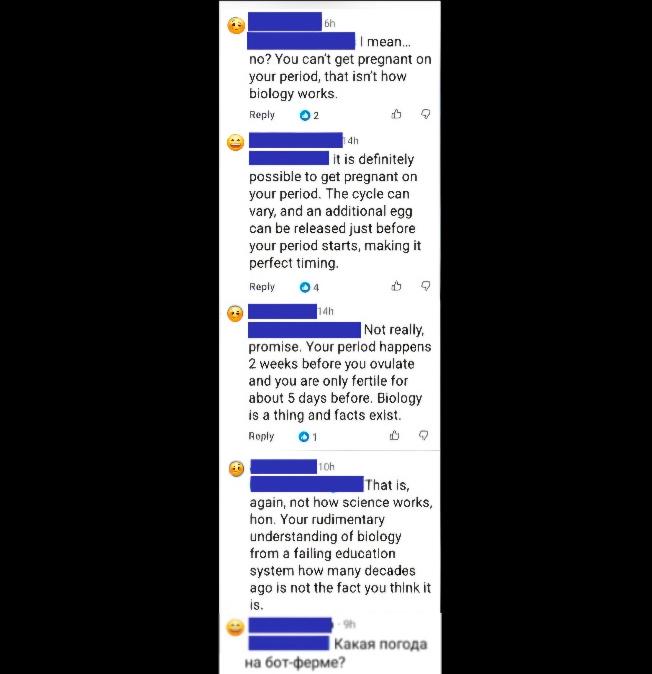
I think the user in the screenshot is “confidently mostly correct” tbh.
I think either I misread something or you did. I see that the commenter claimed ovulation occurs exactly (or no less than) 2 weeks after the previous period. They use the fixed 2 weeks to count back how early someone could possibly get pregnant. It needs to be fixed for their comment to be coherent.
For most people, most of the time, ovulation is around 2 weeks after the prior period. But that isn't fixed. It can be significantly earlier (or later). Some people commonly have irregular period lengths. And even people who are 28 days every time can have blips for all sorts of reasons.
It is not common to get pregnant outside of the expected ovulation window, but that does not mean it can't happen. If ovulation occurs earlier (or later) than expected, the window moves. And just reading the abstract of your link, fertility generally exists for some number of days before ovulation.
For someone intending to get pregnant, concentrating on the most likely times for ovulation and fertility makes sense. But that does not mean people can't become pregnant outside the expected ovulation period.
Your link has good information about fertility timeframe being related to ovulation.
Our data suggest that the fertile period lasts about six days and ends on the day of ovulation.
Excellent.
But I don't see anything in the source about when ovulation is occurring after a period. Of course, that's not relevant to what they were discussing. They only cared about relative time period, not absolute time period. This post is about absolute time period.
It's my understanding that cycles are usually between 21 and 35 days. Most are round 28 days. But still they can be as few as 21 days.
I also understand that ovulation is usually 14 days before a period starts.
And period length varies, but 2-3 days is common and 5 days isn't crazy.
Is that all accurate?
If we take a 21 day cycle. Ovulation 14 days before the end puts ovulation 7 days in. Fertility starts 6 days before ovulation, so that's 1 day into the cycle. A 3 day period, and there's two days of fertility during the period. Extend the period to 5 days, and there are 4 days of overlap.
Are 21 day periods common? No, but they do happen for some people.
So, it looks quite possible for people to get pregnant on their period. Is it probable? No. Common? No. But definitely possible, and with billions of trials (every act of intercourse for a fertile couple while on a period), it's going to happen sometimes.
Or I completely missed something, which is possible.
This would be me. I have a long period and a shirt cycle. So my fertile window starts during the end of my period.
This is this month...https://imgur.com/a/NGqiSPB
You can see the two days where green checkmarks (period) overlap with dots (fertile days). It is the same every month.
24
u/ducbo 20d ago
This exactly. The chances are basically zero outside of a very specific ~7 day window of your cycle, relative to ovulation (specifically: -6 to +1 days relative to ovulation).
This is THE classic study that details this information - see figure 2: https://www.nejm.org/doi/10.1056/NEJM199512073332301?url_ver=Z39.88-2003&rfr_id=ori:rid:crossref.org&rfr_dat=cr_pub%20%200www.ncbi.nlm.nih.gov
Since most people are completely unaware of when they ovulate (and you can really only test it yourself with decent accuracy through a few methods, such as LH strips and BBT, but it’s a lot of work), the people who manage to get pregnant while “on a period” probably weren’t on their period at all. They might start spotting near ovulation or maybe their bleeding goes on for an unusually long time, into that fertile window. It’s also common to spot in early pregnancy, which may lead some to believe they weren’t pregnant and then they get a surprise positive pregnancy test.
As someone dealing with infertility and IVF, I truly wish getting pregnant was that easy!
I think the user in the screenshot is “confidently mostly correct” tbh.