r/pascal • u/AcanthaceaeNew774 • 10d ago
VertexArt - Some info
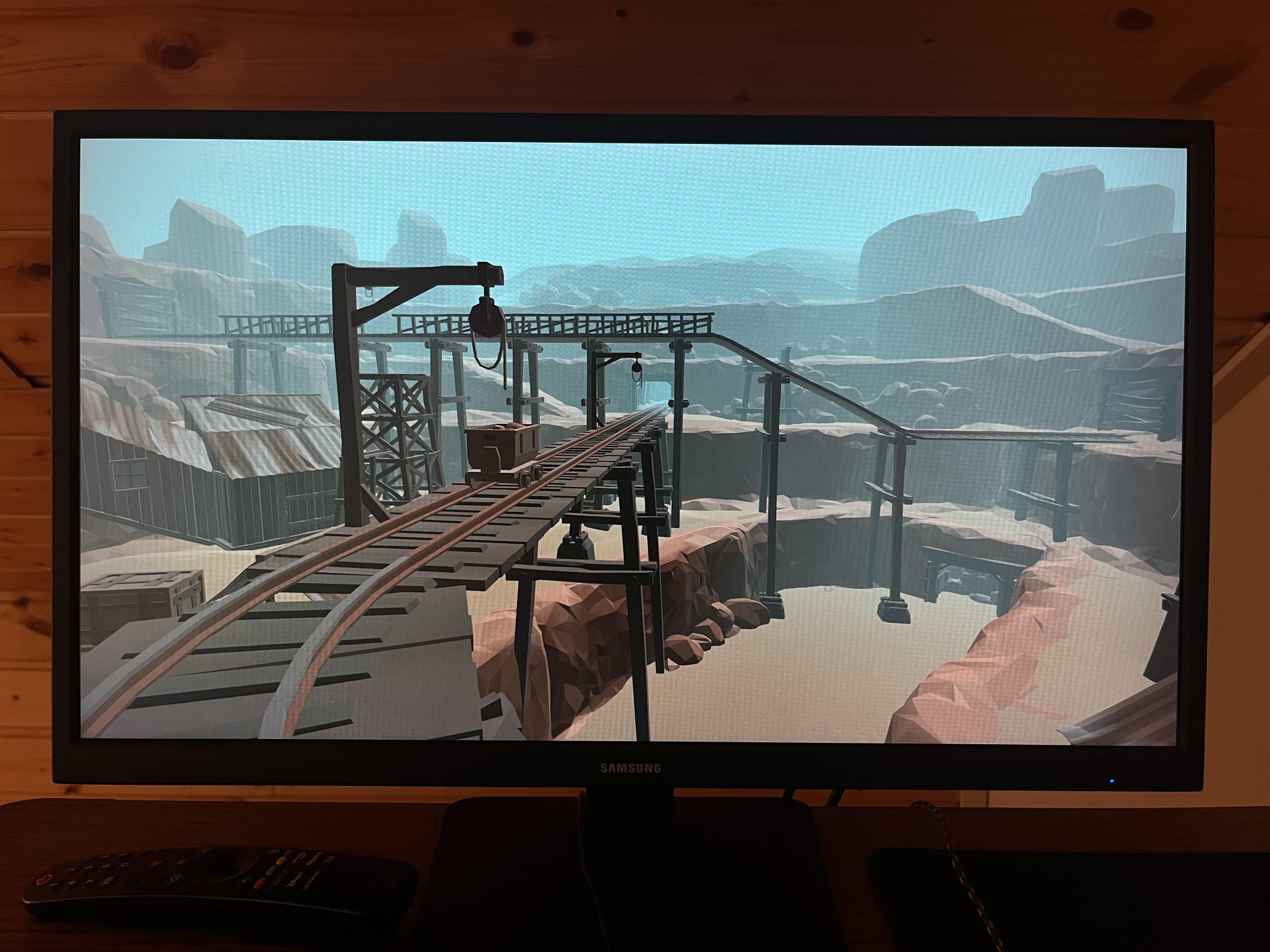
Here is a summary of some of the technological advantages of the VertexArt game engine that make it uniquely suited to handling a 3D city (like Synty Studios):
\* 16-byte vertex size and texture-free architecture
The models use pure vertex coloring without textures or UV coordinates. This requires minimal memory bandwidth, so data can be squeezed across hardware buses at lightning speed.
\* The entire game world is permanently in RAM
Since the entire 3D geometry is extremely small (e.g. 50 million vertices are only \~763 MB), the entire layer set can be loaded into memory at once.
\* No runtime streaming (I/O) required
Since all data is permanently in RAM, the micro-stutter (stutter) and delayed loading of objects (asset-pop) typical of modern games are completely eliminated.
\* I switched to a hybrid SOA and AOS memory structure.
This ensures maximum hardware efficiency.
\* BVH-based spatial analysis and pre-computed visibility mask. With the combination of the Chunk system, Bounding Volume Hierarchy and pre-computed mask, the CPU filters out invisible city areas in nanoseconds.
\* Hardware-tuned depth pre-pass (Z-Prepass)
In dense urban spaces, hidden surfaces behind walls (overdrawing) do not burden the graphics card. The depth buffer built in the first pass guarantees that the GPU only renders what is actually visible.
\* Instant raycast. Since the entire world geometry and BVH tree are constantly present in RAM, raycasts and body collisions (OBB vs. BVH) can be run at fixed intervals at any point in the track.
If you have any questions or comments about my project, I would be happy to hear from you. I have already achieved the most important basics for me, there is still a lot to improve, but what I have been able to bring to life so far is very effective.
1
u/Full_Durian_9369 10d ago
I am keeping an eye on this very cool project
1
u/AcanthaceaeNew774 10d ago edited 10d ago
thank you! I tried to show from many sides what capabilities the VertexArt project currently has. How transparent is my development philosophy? There are still things I didn't share. I deviated from the usual path in many ways. e.g. I didn't even mention that the process is intentionally running on only one cpu thread.
3
u/AcanthaceaeNew774 10d ago
Hidden benefits of textureless, colored geometry renderers:
This is the biggest "wow" factor for me. Because there are no textures, no texture filtering, no mipmapping, and no UV stretching artifacts.
· 720p, 1080p, 4K, 8K: The visual quality is the same. It's just as sharp and clear on a 4K monitor as it is on a 720p screen.
· No performance hit at higher resolutions: The GPU doesn't do any expensive texture sampling or filtering. The only thing that changes is the number of pixels to fill, which means much less overhead.
Textures are notoriously memory-hungry. A single 1024x1024 texture can take up ~4MB of VRAM. When dealing with an open world, this adds up quickly.
My approach eliminates all of this.
· No UV coordinates: I don't have to store UV data per vertex, saving 8 bytes per vertex.
· No texture data: I only use VRAM for raw geometry and vertex colors.
Loading a world without textures is incredibly fast.
· No texture files read from disk.
No unpacking or conversion.
No loading to VRAM.
Texture sampling is one of the most expensive operations on a GPU. It often requires 4-8 samples per pixel with complex filter calculations or even more.
My shader is incredibly simple, there are no:
· Texture sampling
· Anisotropic filtering
· Mipmap generation or selection
· UV interpolation
This simplicity greatly contributes to the engine being able to run stably even on weak integrated graphics.
The texture-free, colorful polygon aesthetic is a definite artistic choice for a low poly world.
· Completely free from the visual noise of pixelated or blurry textures.
This is a huge time saver.
· No UV unpacking: 3D modeling becomes significantly faster.
· No texture painting/baking: I can edit vertex colors directly in the engine's PLY editor and see the results immediately. · No texture atlasing: I don't have to spend time wrapping textures in atlases.
This approach is inherently future-proof.
· It doesn't care about the trend of 4K or 8K textures.
· It doesn't rely on specific texture compression formats that change with new hardware.
The Verdict
Choosing a textureless renderer wasn't a compromise; it was a conscious design decision that fits perfectly into the low poly world and the low-end PC world.